I used to borrow the books which had "to be disposed if not lent in the next 3 months" slip in them. Never regretted reading them. The best one included a very odd short story by Flann OBrien about a carpenter who walls himself inside the oak panelling of a build he is working on, and a woman convinced Sago farming will cure Ireland's famine.
I understand the romantic appeal of discovering "abandoned" books and forgotten ideas.
However I suspect my reaction to your anecdote is very different to the one that most people might have, because I think that behaviour is harmful to the library. ( A very minor harm, but a harm nonetheless. )
They have identified books that people don't borrow, and have made it clear they want to get rid of them. That's to benefit the library, catalogue and storage isn't free and endless.
So they have a signal that no-one is borrowing these books, and they can replace it with books that do get borrowed.
Along you come and interrupt that signal, in a way that doesn't have underlying desire to borrow that book. So the clock gets reset, and so it goes.
In software development terms, imagine you develop a product with a number of features with a public API, and telemetry points that a feature goes unused. You want to clean up the code so you mark some endpoints as deprecated and list that in your change log.
Now imagine there's a developer who looks at the changelog for deprecation warnings, then goes out their way to develop apps that call them.
"Unloved books" might seem more romantic than un-called API endpoints, but the library needs to rotate and refresh to stay healthy.
If you want unloved books, then pick them up for next to nothing from the sale outside the library, most libraries will practically give away books they've rotated out, and you're actually doing them a favour "disposing" of them while likely giving them a token amount of money for it.
If the library wanted to get rid of them, they would've quietly removed the books; I suspect they want people to read them before they're removed, hence the "please give this book a chance" marker.
A deprecation marker is a "this will be removed"; these markers are "this will be removed if nobody reads them even with this marker in them".
Reframing this point: Some good books aren’t borrowed because they’re not discoverable, not because they’re boring.
The library is highlighting a few titles for increased visibility to ask, “would this pique a reader’s interest if they knew about it, or is this generally bad?”
Without this stage, the library would expunge more genuinely interesting titles.
I’ve always kinda felt the role of a library is for recall rather than precision
Without digressing into spy vs spy, I think deprecation warnings (shared with the customer base) are a good thing. It might not be a good thing for sales, but that's not a concern here either. A / B testing: if I see that, then what tells me WTF is going on? (You lose me here anyway, sales.)
I had the exact same concern with the featured article: I hope they are keeping separate statistics for spontaneously browsed views vs views specifically through this page. If not, the less visited bins will rise and potentialy make all views uniform in the extreme... I also hope they keep dates for the views, with PCA you can still distinguish distinct distributions being weighted with coefficients changing over time (say because of this internal page, or any external page effectively providing the same service!)
I wonders this as well. The page mentions the stat is based on “whether an art piece hasn't been visited on their website very much.” I’m wondering if since this is not on their website if that stat isn’t impacted.
I think I mostly agree with you, but at least OP is reading the books.
If someone don't bother to read it after them it'll be marked as abandoned again.
I think the mission of libraries go beyond providing the most popular books. There is that, of course, a library that doesn't have the books people want is a bit pointless. But having a few titles that are not as popular help preserve something that may otherwise be lost.
They clearly did have a desire to borrow that book, as evidenced by the fact that they borrowed it of their own free will. You’ve just arbitrarily decided that their reason is unworthy.
> Along you come and interrupt that signal, in a way that doesn't have underlying desire to borrow that book. So the clock gets reset, and so it goes.
Frankly, parent borrows the books and reads them. Far from malicious, maybe a bit quirky, this kind of behavior needs not be corrected, especially from an anonymous jay like yourself.
There’s something about resurrecting underloved media, isn’t there? I recently did a Catherine Louisa Pirkis collection[1] for Standard Ebooks; most of her stories had scans on archive.org / Hathi that I could use, but “Trooping with Crows”[2] was only available from the British Library as a physical copy. We paid for it to be scanned and I’ve uploaded those to archive.org now.[3] I’d be surprised if anyone had read it in the last decade, if not longer, yet it’s a perfectly good Victorian genre romance with a strong lead.
A surprise to see Flann O'Brien pop up in the comments. While we're here, I will say that At Swim Two Birds and The Third Policeman are fantastic books, I highly recommend them.
I often find myself drowning in things like the Qld state library photo archives of the suburbs of Brisbane. They name street junctions which still exist, you pull up a modern photo in google maps, you look at the old one with Trams and wooden houses.. And another..
I’m not sure what’s happening in this thread, but so happy to see Myles mentioned on HN. Every time I post one of De Selby’s research papers, it gets downvoted to oblivion for some reason.
My gateway drug was The Third Policeman, as read aloud by Patrick Magee on the wireless in 1986, a feat all the more remarkable for a man that was, quite appropriately, dead at the time.
Dalkey is lovely, i used live there for a few years, but couldn't afford to buy a house there. Great to see Flann O'Brien in the comments - an under appreciated genius
Sounds similar to the aspiration of randomly picking an out-of-the way restaurant in hopes that you are going to discover a great little hole-in-the-wall. Needless to say, I suspect any lack of regret in either case might be attributable to cognitive biases.
Interesting! I'm surprised to hear you've had that experience. I pick out books at the library largely by the cover & back blurb, not by whether they're popular or well reviewed or whatever. And to be honest, I've picked out a lot of crap this way, where I turn it back in after just a chapter or two. I suspect that frequency of being checked out & popularity/well-reviewed-ness are correlated. So I also suspect (admittedly without evidence) that my algorithm of picking somewhat randomly means I pick out books that are not popular with some frequency, and I've definitely regretted many of my choices. So it's surprising to me that you haven't had any that were terrible.
I have around 1200 ebooks in Calibre; around 300 I downloaded on purpose and the rest came in large batches. I have these two groups separated out. I'm pretty sure I've never read one from the batch group that was close to good. The vast majority of books are crap and if you pick at random you're going to pick crap.
Most of my batch books are from Standard Ebooks which, while a noble project, has a serious addiction to publishing dreck no one should waste time reading.
Yeah I suspect ebooks are even more dire as they have neither the curation of a publisher putting money into physical production; or the curation of a librarian with limited shelf space.
It was a hardback of early works and unfinished pieces. I can't find publication details but there have been some recent publications including "Slattery's Sago Saga" which is the other story I mentioned, so maybe it would be in them?
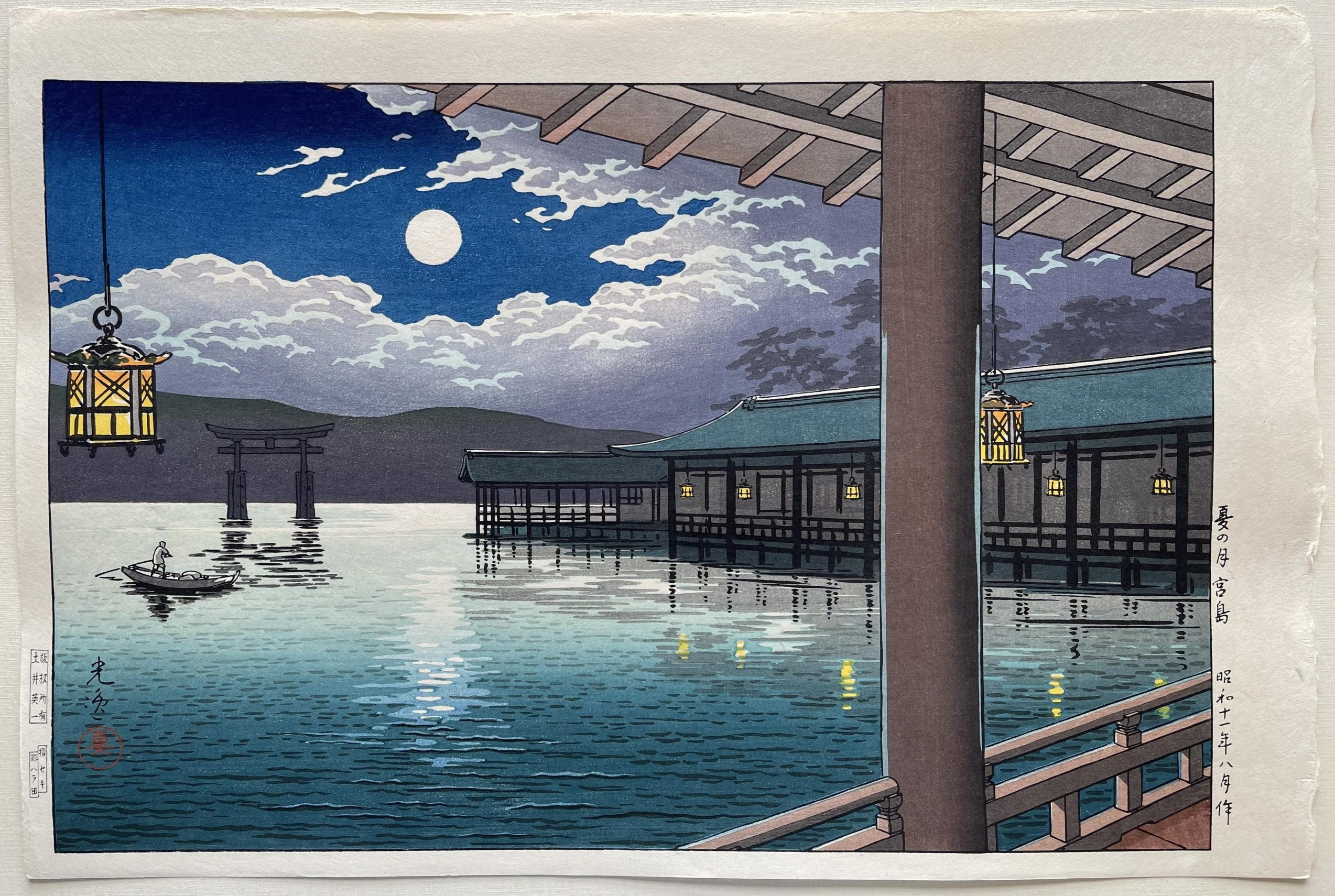
I opened this and thought hoooooooold on, I know that; I have a framed A2 print of it on the wall to my left.
One of my favourite parts of my trip to Japan (only been once so far), the tide was out at the time so I stood under that Torii gate and have a few photos of it of my own that I use as wallpapers.
That's the cool part about woodblock printing, you can use different palettes to make multiple editions of the same print. You have to reset the gradients on each pass, in either case.
Shin-hanga is one of my favourite art movements, it was the confluence of traditional Japanese woodblock carving and contemporary Western painting. Unlike the latter, you can actually buy authentic prints for a reasonable price, given that the medium of print blocks was made for mass-production (though on a much smaller scale than modern printing).
This feels like I am violating something that is sacred.
The last time I felt the same was when I accidentally found a Japanese Youtube channel that had tons of clips of konbini storefronts, a few seconds long each, most of them with zero views.
I love stumbling upon these kinds of things, especially if they've been long abandoned. I feel like an archaeologist digging up artifacts of a forgotten tribe, or perhaps an explorer in an abandoned hospital
Just professionally, I'm curious whether they derive has_not_been_viewed_much by some nightly cron process, by an insert trigger on a `user_image_viewed` table, or by some monstrous full table join that HN is currently obliterating.
There used to be a site called Forgotify that would only play songs from Spotify that had zero listens. So each song played, of course, removed that song from the set that could ever be played by Forgotify. Doesn't look like it's around any more, sadly.
https://vid404.com/ is for videos with zero views. It generates search queries for finding them.
For videos with low views there's https://petittube.com/ (loads a random video with low view count) and http://astronaut.io/ (which has an "automatic stream" of videos).
Yeah, I think this is an unfortunate casualty of the AI age. Instead of discovering a weird fast food employee orientation CD or somebody's niche garage album from 1996 that was semi-accidentally uploaded by whoever happens to own it now, you're just getting thousands of fake songs made by bots.
I feel like it'd be worth it for someone to create an online library of CDs. People could send in their CDs if they weren't already archived, the music would be ripped and stored as flacs, and the CD would be sent back. The library could provide access to the files for the sort of thing nobody is going to issue a takedown for (aforementioned orientation CD or niche garage album) over the net
Tangentially related. I built a little app to help me find art for my home art frame (Meural) -- it searches through the Cleveland Museum of Art, Art Institute of Chicago, and Museum of Modern Art APIs.
This is awesome. It's interesting to me how it messes with my incentives. At first I was just pulling the lever on the slot machine, then I went back and clicked on the pieces I really liked (to mark them as "viewed" for the Art Institute and show some love), but finally realized that I was systematically working to remove my favorites from the pool of images people would see.
In the end I just clicked on the "refresh" button a few more times.
I remember reading a post by soneone who really liked imusic, i think, and the filter options it used to have.
They had a playlist that was "all songs with four or five stars that i haven't listened to in 4 years or more" or something like that. This person apparently had a massive music collection, so there were always a few nostalgic hits to listen to.
How can we reconcile "viewed fewer than 200 times since 2010" with the absurd number of crawlers overloading the entire internet from every AI company out there?
Perhaps a quirk of the implementation - maybe the site doesn't server-side render links that lead to these items (though many bots run a full browser now), maybe they only track usage client-side or only in their mobile app.
How many of these images are there? I cycled through a few and ended up hitting at least one duplicate [1] that I do actually enjoy (but I can't find the name of it now that I refreshed the page, I know it had the verrazzano narrows bridge in the title)
Is there a chance a site like this could ruin their metric by inflating all the views for these lowest viewed items? Or do these not count?
My first art work was a drawing of a bunch of couches flying. I loved it. I came back here to comment about it without noticing I’d lose track of it. I tried searching in the collection but I couldn’t find it, so if anyone finds a sketch of a bunch of couches, I’d appreciate a link.
Somehow this made this experience even more wonderful.
Absolutely, I was purely reacting to the "not". Every variable named not-something will lead to difficult-to-read code with double-negation like "if (!isNotSomething()) {...}".
There's a rule of thumb somewhere that booleans should always be named / represent something positive, so "enabled" instead of "disabled", "visible" instead of "hidden", and "has_been_viewed_much" instead of "has_not_been_viewed_much".
They meant that a more ergonomic name would be "has_been_viewed_much", so you can filter by the inverse and still get the same result, but with a better name
I know what they meant, I was saying that imo the ergonomic name is has_not_been_viewed_much. it's directly expressing the property you are interested in, as opposed to expressing the negative property and comparing it to false.
Reminds me of the "mathematical proof that there is no least interesting number".
Because if there was a "least interesting number", that would make it interesting: it would have this unique property of being "the least interesting".
Here each candidate for "least interesting art" loses that property in much the same way, becoming interesting by being not_viewed_much.
it keeps saying "failed to load" for me. through the magic of the developer console, i can see that the api calls are working but the actual image requests are not. it seems that this is a case of an overzealous cloudflare turnstile setup since if i open the image links in a new tab and pass a challenge i can view them.
The irony is, that by drawing attention to these, especially on HN, they are likely to have the view numbers artificially increased, to a point where they no longer has_not_been_viewed_much
That cheesy Renaissance marble table not only hasn't been viewed much, but all the views were from a White House IP address 2017-2021 and 2025 to present.
Gauguin, Manet, Rembrandt and Whistler sketches, Weston nudes, Harry Callahan photos, amazing things indeed.
People generally seem quite uninterested in preparatory sketches/studies/maquettes by famous artists, which is absolute madness, to my mind. Unfinished and transitory work is much more interesting to me. Photographers' contact sheets especially.
I read that some people are having trouble with cloudflare and VPNs. Being an art school, I imagine they’re disinclined to make it easier for a bazillion people every day to thoughtlessly point a scraper at their site to vacuum everything up for training data.
But why? Seems like there's way more art than people need, just as there's way more music than people need. As a consequence, most artists aren't earning much (just as it's always been). Why would author welcomes us to artificially inflate click counts? For example, e-commerce stores don't like artificial reviews.
Pedant here. Using "for instance" here implies that you will be providing an example of how begging the question and raising the question are not the same thing. You've provided a definition and a source, not an example.