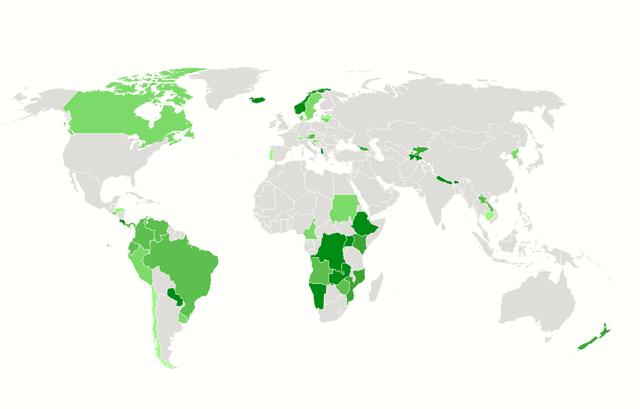
Let's head to electricitymaps.com !
Albania (https://app.electricitymaps.com/map/zone/AL/live/fifteen_min...)
- On 2026-04-12 16:45 GMT+2, 22,67% of electricity consumed by Albania is imported from Greece, which generates 22% of its electricity from gas. Interestingly, Albania exports about as much to Montenegro as it imports from Greece.
Bhutan:
- 100% hydro, makes perfect sense
Nepal:
- 98% hydro, a bit of solar for good measure
Iceland:
- 70% hydro, 30% geo
Paraguay:
- 99,9% hydro
Ethiopia:
- 96,4% hydro
DRC
- 99.6% hydro
So, the lessons for all other countries in the world is pretty clear: grow yourselves some mountains, dig yourselves a big river, and dam, baby, dam !!
    (I'm kidding, but I'm sure someone has a pie-in-the-sky geoengineering startup
    about to disrupt topography using either AI, blockchain, or both.)
Being powered almost entirely by hydro means that the system is highly susceptible to droughts, so then they either have to spin up those oil plants from time to time or import electricity from abroad. I think it's also worth pointing out that nothing really changed because of climate change, the decision to rely on hydro was made in the 90s. The country used to have its own oil power plant that it heavily relied on before that decision, which slowly produced less and less until it was shut down for good in 2007. Some images of it from 2019: https://www.oneman-onemap.com/en/2019/06/26/the-abandoned-po...
I wonder how many other countries are increasing non-renewable output?
https://en.wikipedia.org/wiki/List_of_power_stations_in_Sri_...
Why do you think it is worth pointing this out?
It's helpful to know that there are economics and environmental concerns outside of an existential threat, to galvanize a country's momentum.
https://www.dw.com/en/gerd-grand-ethiopian-renaissance-dam-s...
Motuo Hydropower Station - will overtake the Three Gorges dam as the world's largest. The project has attracted criticism for its potential impact on millions of Indians and Bangladeshis living downriver, as well as the surrounding environment and local Tibetans.
The global average to build one is ~7 years. People have been saying they take too long to build as an excuse for not building them for what, two decades or more? It seems to be taking longer to not build them than to build them.
> By the time a new plant is ready, alternate sources (likely solar + battery and long-distance HVDC) will have eaten its lunch.
Neither of those have the same purpose. Solar + battery lets you generate power with solar at noon and then use it after sunset. It doesn't let you generate power with solar in July and then use it in January. More than a third of US energy consumption is for heating which is a terrible match for solar because the demand is nearly the exact inverse of solar's generation profile both in terms of time of day and seasonally.
HVDC is pretty overrated in general. It does nothing for the seasonal problem and it's expensive for something that only provides a significant benefit a small minority of the time, i.e. the two days out of the year when the entire local grid has a shortage but a far away one has a surplus. It's also hard to secure because it inherently spans long distances so you can't have anything like a containment building around it and you end up with an infrastructure where multiple GW of grid capacity is susceptible to accidental or purposeful disruption by any idiot with a shovel or a mylar balloon.
For commercialization, solar makes more sense as there is a much better return on capital.
If I were king, I’d do socialized power and have the government capitalize and own the nuclear plants, and bid out the operations to private entities. Government has better debt economics and doesn’t care about return in monetary means.
Even then, relatively small tweaks to tax law and some grid investment would create a solar boom at lower cost. Every Walmart parking lot and some road infrastructure should be covered with solar. Interstates could be utility and generating corridors - they aren’t because federal law makes any multimodal use very difficult.
There isn't really an "obsolete" after it comes online because things get built when expected revenue exceeds construction costs + operating costs, but once built (or close enough to completion) they continue to operate as long as revenue exceeds only operating costs because by then the construction cost is in the past. When the construction cost is large, the amount the price of electricity would have to decline to fall below operating costs is equally large. And investing in something where you expected a positive ROI and you ended up with a slightly negative ROI clearly isn't what you'd have preferred, but it isn't nearly as bad as the -100% ROI you'd get from shutting down the plant instead of selling it for slightly less than what you put in. There's a reason the US is not only continuing to operate 20th century nuclear plants but even looking to reactivate some of the ones that have already been decommissioned.
Moreover, solar has the same problem. You invest in a solar farm because you're expecting to profitably sell power at current prices, but if e.g. the AI thing turns out to be a bubble then there will be oversupply and current prices won't stick. Solar also has the added "everybody is doing it" risk. If you and everybody else add solar then the price at times when solar output is highest is going to be lowest and vice versa, i.e. if too many people invest in the same type of generation then your output gets inversely correlated with the market price, which is bad for ROI.
Think of it this way: if you buy a house, the “operating cost” is fairly small: upkeep and painting, mostly. Does that mean you can buy a house, move out of your apartment, and quit your job, because your cost of living has just dropped a few thousand a month?
No, of course not. Upkeep isn’t the real cost of buying a house. The real cost is the monthly mortgage payment. Unless you were already independently wealthy, you have to keep your job. Sorry.
The cost of energy for a nuclear plant is the cost of paying back the loans. As other forms of power generation get cheaper, those loans stay the same, making it harder and harder for nuclear to compete. As they get squeezed out of the energy market, they have to raise their per-watt prices in order to continuing to service the loans.
Think of it like this. You rent your house to your cousin, who pays you enough to cover the mortgage. But then your cousin finds a sweet deal couch-surfing in the tropics in the summer. He stops paying you for June, July, and August. You can’t get anybody else in your house during that time, so you say, “Sorry dude, you have to pay more for the rest of the year. I’ve got bills to pay.” That works great until your cousin gets tired of your high prices and moves out, and now you’re left with a mortgage to pay and no one renting it.
That isn't a future cost, it's a past cost with a future payment date. It's like taking out a mortgage on a piece of land to buy some lumber and build a house on it. The past cost is buying the lumber; the hardware store isn't going to give you a refund six months after you already paid them and used the lumber to build the house. What you have now is a house instead of money and separately a mortgage against the house.
What do you think happens if you don't pay the loan? Is the bank going to get a refund from the hardware store? No, they're going to take the house, sell it to someone else for whatever they can get for it and apply the money to the loan. And then the house continues to operate as a house.
The same thing happens with a power plant. If the plant company itself has a bank loan and isn't making enough to pay it, the bank is going to foreclose, sell the plant to someone else, possibly take a partial loss, and the new owner -- who might have gotten the plant for a lower price than it originally cost to build -- is going to continue to operate it as long as its revenue exceeds its operating costs.
And that's assuming the plant was funded with a bank loan. If it had investors then there is no loan payment; the "loan payment" is when the company pays the owners dividends. If they were expecting the plant to pay enough dividends to recover their initial investment plus interest and its operations only generate enough revenue to repay most of the original investment but no interest, then they continue to operate the plant (or sell it to someone who does) because "recover 90% of the original money instead of the expected 200% of the original money" is still significantly more than "recover 0% of the original money by closing the plant".
That’s not necessary. Solar panels are so cheap that you can massively overprovision for winter and still come out ahead of nuclear.
Only you don't. In latitudes that get winter, solar output is only about a quarter as much in the winter as in the summer. You often hear things like "twice as much in the warmer half of the year" to try and stuff October and March into the "colder half" and disguise how screwed you are in December and January. Worse, if you electrify heating then it's not just that solar supplies less in the winter, you also have more demand in the winter.
By this point you're not just overbuilding by a bit, you'd need five times as much or more in January as in July. "Five times as much" is already over what it costs to use nuclear. Then it gets worse, because you now have a price of zero during the summer and even the spring and fall because of the massive oversupply and lower demand, so you now have to recover the entire cost of the overbuild during the three months when you're generating the least amount of power.
Then it gets worse yet, because heating demand is higher at night and we haven't yet added the cost of storage.
So we end up using nuclear 1/4 of the time. But unfortunately, nuclear’s cost is in the capital expense, not the operating expense. We pay about the same amount for it regardless of whether we’re using it or not. So if we’re only using 1/4 the energy, the cost per watt of nuclear energy is effectively 4x larger.
This incentivizes further build-out of solar, catching those sweet winter profits (now 4x larger!), further squeezing nuclear’s usage, driving up its prices, and incentivizing even more solar.
Eventually nuclear gets squeezed out and solar’s profit margins go from “astronomical” (naturally, it’s power from the sun, nyuck nyuck) to “low margin.” But they’re still making money. Whoever built the nuclear plant is left with a very expensive stranded asset.
At least, that’s my understanding. I’m not a power company accountant. What I observe, though, is that power companies who do employ accountants aren’t building nuclear. They’re building shit-tons of solar. And I’m pretty sure it’s not because they’re hippies who hate nuclear.
The way energy markets work is that prices change based on supply and demand. So you build a lot of solar and then the price goes down at times when solar generation is high. (There isn't really enough solar in the grid for this to have happened yet in most places.)
Because nuclear has high capital costs but low unit costs, it continues generating all the time even if prices are lower some of the time. It needs to hit a particular average price but will take essentially any instantaneous price. It can't operate with an average price of $0.02/kWh but it can sell for that at noon in July as long as it's getting enough to offset it at midnight in December.
So, you add a bunch of solar to the grid and as a result the price of electricity during daylight hours in the summer falls below the average breakeven cost for solar. Nuclear is still getting more than that at night, when the price won't fall below the daytime price plus the cost of storage, and in the winter, when solar output is lower and heating demand is higher.
Because it's still recovering a lot of its costs on summer nights and even a little bit on summer days, the winter price nuclear needs never gets to be 4x as high, but it goes up some.
Now the solar companies are looking at that price and trying to decide whether it's worth getting. If they add more solar it's going to generate e.g. 4kW in summer, 2kW in spring, 2kW in fall and 1kW in winter. So for every 9kWh they generate, only 1kWh comes in winter, and that's during the day.
Suppose solar needs to average $0.04/kWh to be sustainable but we're already at $0.02/kWh in the spring, summer and fall. Then solar needs the price during the day in winter to be at least $0.20/kWh before wanting to add more. On top of that, if they do add more, then the price during other seasons drops. If those hit $0.01/kWh during the day then solar needs the price during the day in winter to be $0.28/kWh. And, of course, then the price in the other seasons would drop again, until solar would need to have $0.36/kWh in the winter because by then they would only be getting paid in the winter. Whereas nuclear still makes some in the summer at night.
On top of this the demand is higher in the winter at night, but it's not higher in the summer at night. So to use solar with storage, you would also have to amortize the cost of the additional storage during only the winter months. And the winter nights have more hours than the days, don't forget. So for solar to supply all power in the winter it needs the daytime price to be $0.36/kWh and the nighttime price to be more than twice that.
Then solar is intermittent. People still need heat when it's cloudy. Overbuilding solar sufficiently to handle the heating load on a cold cloudy day in winter? Nope. Hopeless. You'd have to use long-term storage in addition to short-term storage and that's a whole new category of expensive when we were already looking at prices nobody was going to like.
So what happens instead? Well, probably the daytime price in the non-winter months gets to something like $0.02/kWh and the daytime price in the winter gets to something like $0.20/kWh and you fall below the breakeven point for building more solar. Then nuclear takes the same $0.02 and $0.20 during the day and something more than that at night and continues to cover its costs.
Really the problem here is not that solar is going to push out nuclear in the winter, it's that natural gas could unless you have a price on CO2. Or more likely, without a carbon price people might not switch to electric heat instead of continuing to heat with natural gas and fuel oil.
So we kind of need a carbon price to do heating. Or to solve it from the other side (which would be even better), we need to get nuclear to be more cost efficient so it can out-compete natural gas since solar won't.
But I guess the whole calculation of 100% renewables is overprovision+storage. This wouldn't change with nuclear in the mix, nuclear would just generate all the time at whatever price it can get, just bringing the point of overprovision for renewables closer.
Then in countries in more extreme latitudes the calculation of if nuclear is worth it just becomes how cheap and viable the (long and short-term) storage part will get over the lifetime of a new nuclear reactor.
If storage gets so cheap that a nuclear reactor would be consistently in the red, even in the depths of winter, then it wouldn't make sense to build one today.
But I haven't done any calculations on that yet. For example for the Netherlands or Germany which still have a high reliance on gas but a large portion of solar+wind, how expensive nuclear could be for it to make sense to build a new reactor. And under which scenarios of development of storage prices it would potentially seize to make sense.
During the coldest winter month, solar energy produce (as per statistics from the solar industry in Sweden) somewhere around 3-7% of the amount produced during the warmest month. Households also consume around 2-4 times the amount of energy during the coldest month compared to the warmest month. Sweden is a country where only a small minority have air conditioning installed at home.
Those are the worst month vs the best month. Overall the winter is not that bad, but it is still pretty bad for solar. Talking with people who has had solar installed here, the general story is very similar. During periods where it do produce the market price is already exceptional low, so it isn't returning a major saving. When the market price is high, the output is low, forcing them to be connected to the grid and pay whatever the electrical company demand during the highest market peaks, as well as taxes and grid fees which themselves has increased to match the cost of high variability.
All this looks very different in countries with much warmer climates and where the major energy consumption from households are air conditioning.
You also can't ignore wind power which should be part of any plan to "overbuild".
So is comparing rooftop solar for a single property to grid solar for a country to a continent-sized grid of mixed renewable sources.
Battery and storage tech are barely getting started. Pumped storage is perfectly capable of smoothing out seasonal loads.
There's some capex for physical pumped storage - less than for a nuke plant - but once running it's comparatively low cost.
1. Sweden is just about the worst case, there's very few countries/people that far north.
2. There's this genius invention called "wires". HVDC has transmission losses on the order of 3.5% per 1,000km. You don't have to colocate the solar.
Sweden is worse but it's still a significant issue in e.g. New York or Paris or Auckland.
> There's genius invention called "wires". HVDC has transmission losses on the order of 3.5% per 1,000km. You don't have to colocate the solar.
It's more than 1000km from the places that get cold to a part of the world where it isn't winter.
Suppose we ignore that it's winter in the US Northeast and Southeast at the same time and run HVDC 2000+ km to Florida because it gets an extra hour of sunlight. Long distance transmission can't be used to counter seasonal output and regional weather at the same time because one requires the generation to be spread everywhere and the other requires it to be concentrated closer to the equator. If we concentrate the solar in Florida to mitigate winter in New England then we're screwed when Florida is overcast.
No it isn't.
Wires still might be worth it, but these are all close enough to the equator that you can just over provision locally without issue if you prefer.
> It's more than 1000km from the places that get cold
Solar panels work better in the cold. The issue is with how far from the equator Sweden is, not how cold it is.
In the US Northeast solar generates around four times as much in July as December. This is sufficiently bad when what you need is more power in the winter. Paris is a little worse. Sweden is significantly worse.
> Wires still might be worth it, but these are all close enough to the equator that you can just over provision locally without issue if you prefer.
If I need 25% more output in the month when solar has 75% less output, how much do I have to over-provision?
> Solar panels work better in the cold.
Places that need more electricity in the winter because they're cold are cold in the winter because they're further away from the equator.
Nope, it isn't. Solar is cheap and the costs are continuing to fall quickly. Generating 5x more power in the summer than needed is perfectly fine and just a nice added bonus.
Wires are probably a good idea to reduce that number, but with how solar panels are dropping in price traditional forms of electricity generation (nuclear, fossil fuels, etc) just won't be competitive at that multiplier even without them.
> Places that need more electricity in the winter because they're cold are cold in the winter because they're further away from the equator.
Temperature has a lot to do with ocean currents. NY and Sweden overlap in how cold they are (taking the right parts of both). The southernmost point of Sweden is at 55.3 degrees north, the northermost point of NY is at 45.0 degrees north. They aren't even close to overlapping in how far north they are.
During crisis nations are going to restrict exporting electricity and prioritizing their own residents. Electricity that is generated in Germany is not going to warm up Nordic countries if Germany doesn't let it.
Wires are also susceptible to sabotage, especially undersea ones (which are the current major connection points to Europe).
The GP essentially framed overprovisioned solar as solution to anyone who might rely on nuclear without taking in account realities in many countries.
You sure overprovision factor of 200x is still cheaper? This is when looking at the peak generation. From what I understand solar has about 30-40% capacity factor in summer. Just to panels (I'm not sure about total cost of grid-scale solar) seem to be about $300k per rated 1MW or $750k per 1MW during peak. $150M per 1MW during December. OL3 cost about 11B € for 1.44GW (assuming 90% capacity factor) or 7M € per MW.
Unless there has been some huge overnight exchange rate change 7M € seems much cheaper than $150M. Latter of course would actually be much higher when you factor in rest of the equipment, labor etc. Some numbers I found say that it's probably 5x higher.
2. Do you realize the consequences of casually overprovisioning solar capacity when it uses orders of magnitude more land than nuclear per kWh produced ? Source : https://ourworldindata.org/land-use-per-energy-source
https://www.cleanenergywire.org/news/germany-starts-construc...
Fossil fuels and biomass kill many more people than nuclear and modern renewables per unit of electricity. Coal is, by far, the dirtiest.
https://ourworldindata.org/nuclear-energy#safety-of-nuclear-...
I don't doubt that that resulting number is still very low, or there (being intentionally optimistic about politics and society here) wouldn't be any nuclear plants.
Especially long-term storage is tricky, and if you need to consider time horizons of millenia, even small risks add up.
> Significantly more people have died installing solar panels by falling off of roofs.
In fairness, you then also have to consider "regular" industrial accidents at nuclear plants, which are probably still much lower (due to the presumably much higher energy output per employee hour than other forms). But that's besides the larger point of low probability and historical risk.
The data is sparse because the rate is very low. If the world used twice as much nuclear power as it does now, we don't have enough statistical data to predict with high accuracy if something as bad as Chernobyl would happen two more times or zero more times but the existing data allows us to be pretty confident it wouldn't be 100 more times. Meanwhile coal kills more people than 100 Chernobyls every year in just the US.
There is also reason to suspect Chernobyl was an outlier because the USSR was such an authoritarian nightmare. They not only screwed up the design of the reactor (positive void coefficient, no containment building) but then also its operation and the response. The majority of the confirmed deaths were plant workers and emergency responders who got radiation exposure after being sent in without training or relevant equipment. It took the USSR more than three days to admit that it had even happened so that people living next to the plant would know to leave the immediate area. Screwing it up that bad required more than an honest mistake.
> Especially long-term storage is tricky, and if you need to consider time horizons of millenia, even small risks add up.
The "thousands of years" thing is essentially fake. Radiological half-life is the inverse of intensity. Things with a half-life of five minutes are super radioactive. Things with a half-life of thousands of years aren't much above background.
For example, there is an isotope of uranium that has a half-life of four billion years. It's also a pain because its decay chain contains radon gas. ZOMG what are we going to do with it for that long? Well, that's the one that represents 99.3% of natural uranium straight out of the ground, which is why homes in areas with natural granite need radon reduction systems, so it turns out the answer to what we do with it is we can put it in a reactor and use it to generate electricity and that will turn it into something with a shorter half life that goes away sooner. And the major ones that are "thousands of years" can also be used to generate electricity if we would actually separate them and use them for that to get rid of them instead of wringing our hands about where we're supposed to keep them.
> In fairness, you then also have to consider "regular" industrial accidents at nuclear plants, which are probably still much lower (due to the presumably much higher energy output per employee hour than other forms).
It's also lower because nuclear plants are pretty obsessive about safety vs. random solar installation company whose job application test is to see if you can make it onto a third story roof with a two story ladder.
The difference between renewables and nuclear power is who gets harmed.
When dealing with nuclear accidents entire populations are forced into life changing evacuations, if all goes well.
For renewables the only harm that comes are for the people who has chosen to work in the industry. And the workplace hazards are the same as any other industry working with heavy things and electric equipment.
We are definitively not including hydro power and their dam projects in that category.
The reason a ton of dams exists is not to make power, it is manage the river. Making power is a secondary concern.
But when we’re done with climate change we should of course restore as many rivers as possible due to the ecosystem damage they cause.
There have been multiple nuclear accidents in the US:
https://en.wikipedia.org/wiki/Nuclear_reactor_accidents_in_t...
Which of them resulted in "entire populations [] forced into life changing evacuations"? Which ones were the implied something worse than that and what happened then?
> For renewables the only harm that comes are for the people who has chosen to work in the industry.
Solar panels are essentially semiconductors. "Silicon valley" is called that because they used to actually make such things there. You can tell from the number of superfund sites.
"The newer ones are safer" has a certain symmetry to it, right?
> And the workplace hazards are the same as any other industry working with heavy things and electric equipment.
Those things are actually the dangerous things though? There were no fatalities from Three Mile Island but a plant worker at a nuclear power plant in Arkansas was killed and several others injured when a crane collapsed and a generator fell on them. Power company line workers have a worse-than-average fatality rate from getting electrocuted.
The worst nuclear accident involving a nuclear plant (Chernobyl, which occurred in a country without regulation for all intent and purpose) killed less people than the food processing industry cause every year (and I'm not counting long term health effect of junk food, just contamination incidents in the processing units leading to deadly intoxications of consumers).
In countries with regulations there's been 2 “major accidents”: TMI killed no one, Fukushima killed 1 guy and injured 24, in the plant itself. In any industries that would be considered workplace safety violation, not “major accident”… And it occurred in the middle of, and because, a tsunami which killed 19000!
I'm actually happy this regulation exist because that's why there ate so little accidents, but claiming that it's still hazardous despite the regulations is preposterous.
The chernobyl was poisoning Russian soldiers by the start of Ukrainian invasion when they were dumb enough to sleep there.
As usual, when such things are mentioned, you lack any and all sense of scale and statistics. Just pure fearmongering.
Look at the number of all nuclear plants over their entire lifetime and divide their benefits by the cost of what, the two or three major incidents you can think of? This simple calculation alone makes your arguments utterly ridiculous. We accept 1000x the risk and cost of that on a daily basis, in e.g. driving, gas and coal plants.
Go ahead and evacuate to get away from the negative effects of soot, tire dust, CO2, and all the other fun pollution that's spread out over the entire atmosphere. Good luck living on Mars.
If we only tolerated the same long term risk level for food, you wouldn't be be eating anything but organic vegetables. The fact that we put a sarcophagus to prevent material from leaking is just the reflection of the accepted limits. Flint water crisis was much more dangerous than leaving Chernobyl without the latest sarcophagus but nobody cared for a decade.
> The chernobyl was poisoning Russian soldiers by the start of Ukrainian invasion
The stories of acute radiation poisoning have been debunked repeatedly, there simply isn't enough radioactive material left there to cause such symptoms (it's still a very bad idea to eat mushrooms or the meat of wild animals living there, you'd risk long term cancer, but nothing close to acute radiation poisoning, it's simply not possible from a physics standpoint).
And again, we're talking about an accident that happened in Soviet Union on a reactor absolutely not designed with safety in mind and with a Soviet party member who threatened the engineers into bypassing safety mechanism in order to operate outside of the design domain of the plant. And the resulting accident was nowhere near close to the Bhopal catastrophe.
Chemical site have deadly accidents every other years and nobody seems to care but they'll obsess about nuclear ones even when they barely kill anyone. And chemical plants accident do leave long lasting pollution with durable health effect, but we don't permanently evacuate the places because we tolerate the risk.
If there's magic that makes em massively cheaper someone should tell France.
> Some of the driving factors are definitely regulatory. After the Three Mile Island accident, for example, regulators “required increased documentation of safety-compliant construction practices, prompting companies to develop quality assurance programs to manage the correct use and testing of safety-related equipment and nuclear construction material.” Putting those programs in place and ensuring that documentation both added costs to the projects.
> But those were far from the only costs. They cite a worker survey that indicated that about a quarter of the unproductive labor time came because the workers were waiting for either tools or materials to become available. In a lot of other cases, construction procedures were changed in the middle of the build, leading to confusion and delays. Finally, there was the general decrease in performance noted above. All told, problems that reduced the construction efficiency contributed nearly 70 percent to the increased costs.
> By contrast, R&D-related expenses, which included both regulatory changes and things like the identification of better materials or designs, accounted for the other third of the increases. Often, a single change met several R&D goals, so assigning the full third to regulatory changes is probably an over-estimate.
> So, while safety regulations added to the costs, they were far from the primary factor. And deciding whether they were worthwhile costs would require a detailed analysis of every regulatory change in light of accidents like Three Mile Island and Fukushima.
https://arstechnica.com/science/2020/11/why-are-nuclear-plan...
The Hinckley Point C EPR reactor would have produced electricity at a rate below £20/MWh instead of a planned £80/MWh if it was financed by government bonds.
Nuclear won't save the planet, as few countries can develop a nuclear industry. But for countries that have one, it should be a no brainer if not for irrational nuclear bomb fears.
And in the current geopolitical climate, expect more countries to build a bomb.
You can finance the competition in the same way and get similarly cheaper prices.
Hinkley Point C just got a loan at a 7% interest rate to finish the plant. That is after about all uncertainty should already have been discovered.
Now add making a profit and factor in the risk on top and you’ll end up with electricity costing $400 per MWh
Not sure what risk you think come from renewables and storage?
There's still some cost factored in, unlike any other industry where the government is expected to clean up after the fact.
> Not sure what risk you think come from renewables
The grid collapse risk (See what happened in Spain last year, which caused 8 deaths, more than every nuclear power plant accidents in the Western world combined…). Grid operators are currently investing a trillion Euro in the EU alone in order to adapt the grid to the new challenges caused by intermittent and distributed energy sources, and this will never be accounted for in renewable electricity prices… (hence the paradox: the more “cheap energy” is being deployed in Europe, the more expensive the electricity prices become).
> and storage
"Storage" doesn't exist yet as a most people imagine it. Batteries can help ease a few hours of peak load/low supply but that's pretty much it, pumped storage is very situational with limited deployment capabilities. So the risk is that the technology simply never materialize.
The finished grid will be far more robust, better able to handle local outages and issues, and generally more adaptive and open to development in various directions.
As for "cheap energy" raising prices - prices rose a little after Covid, but there's been no constant march upwards. The main driver of higher prices is gas, and eliminating gas dependence, for both for financial and strategic reasons, is a key goal.
The current situation in Iran is likely to increase that motivation.
A key point about renewables is that power doesn't rely on imports from war zones.
In my part of the world the authorities can demand a clean up bond as part of giving permission to build the project. That is done to ensure that you can’t skimp on your responsibilities.
Then I just see misinformation on the Iberian blackout. Please go ahead and tell me how thermal planes not delivering the expected reactive power was caused by renewables.
Please tell me how renewables can’t deliver reactive power when the US and all other sane grids have required them to do it for close to a decade.
And with that we’re solving high 90s% of the grid. Don’t let perfect be the enemy of good enough when we still need to solve agriculture, construction, aviation, maritime shipping, industry and so on.
All ignoring that storage on larger scales already exists.
I'm stopping here since you don't seem to be interested in facts at all.
https://www.entsoe.eu/publications/blackout/28-april-2025-ib...
And then you deny the local law in my jurisdiction, because you can’t accept the outcome.
Then you say that this FERC requirement for renewables managing reactive power from 2016 does not exist.
https://www.ferc.gov/sites/default/files/2020-06/RM16-1-000....
Why are you so afraid of renewables and storage? Why can’t you stay with the truth?
Not in China apparently
Exactly what "storage" means there is the key, especially at high latitude. Do not assume just batteries.
My state (NSW, Australia) for example uses no less then 6 GW at all times of day. Variable load is on top of that during the day.
If we had 6GW of nuclear plants, our grid would be almost completely green and they'd run at 100% utilization.
You’ll end up at $400 per MWh excluding transmissions costs, taxes etc.
Your state already has coal plants forced to become peakers or be decommissioned because no one wants their expensive electricity during the daytime. Let alone a horrifyingly expensive new built nuclear plant.
https://www.abc.net.au/news/2024-10-13/australian-coal-plant...
Nuclear plants can't do instant demand response, but they can absolutely respond over windows of several hours.
For the French to do load following they sync their entire fleet to manage it. Letting plants take turns and spread out where they are in their fuel cycle.
You need solar. Make hydro the backup, fill reservoirs as your reserve and sell extra energy when they're nearly full.
https://en.wikipedia.org/wiki/Grand_Ethiopian_Renaissance_Da...
It uses enormous amounts of land and capital to build, and is ongoingly dangerous in a unique way. If LiFePO4 can do 4 hours at full output already, and be placed anywhere using volume manufacturing to expand, then batteries are straight up better.
Pumped hydro is an expensive dead end.
"Base load" is just some nonsense from nuclear fans to get the cost per GWh down.
PS France has the cleanest grid in Europe
You can't quickly change the amount of power it generates. Which is what you need if you want to use it together with dirt cheap solar.
It's very expensive. In fact, noone knows how expensive it will end up being after a couple thousand of years.
It's dangerous. For millenia. Vulnerable to terrorism. Enabler of nuclear weapons.
It takes a long time to build and bring online.
It doesn't scale down.
Finally, Kasachstan is the major producer of Uranium. Yay?
You always need something in the grid that can change the amount of power it generates regardless of what you use in combination with it, because the demand from the grid isn't fixed. All grids need something in the nature of storage/hydro or peaker plants.
The advantage of combining solar with nuclear is that their generation profiles are different. Nuclear can generate power at night and doesn't have lower output during the peak seasonal demand period for heating. Nuclear is baseload; it doesn't make sense to have more of it than the minimum load on the grid, but no one is really proposing to. The minimum load is generally around half of the maximum load.
> It's very expensive. In fact, noone knows how expensive it will end up being after a couple thousand of years.
If you actually reprocess the fuel there is no "couple thousand of years". If you instead put it in a dry hole in the desert, you have a desert where nobody wanted to live to begin with that now has a box of hot rocks sealed in it. It's not clear how this is supposed to cost an unforeseeable amount of money.
> Vulnerable to terrorism.
Nuclear plants are kind of a hard target. The stuff inside them isn't any more of a biohazard than what's in a thousand other chemical/industrial plants that aren't surrounded in thick concrete.
> Enabler of nuclear weapons.
The US already has nuclear weapons and would continue to do so regardless of how much electricity is generated from what sources. The argument against building nuclear reactors in Iran is not an argument against building nuclear reactors in Ohio.
> It takes a long time to build and bring online.
Better get started then.
> It doesn't scale down.
Decent argument for not having one in your house; not a great argument for not having one in your state.
> Finally, Kasachstan is the major producer of Uranium. Yay?
The country with the largest uranium reserves is Australia. Kazakhstan is #2 and has about the same amount as Canada. Other countries with significant reserves include Russia, India, Brazil, China, Ukraine and several countries in Africa. The US has some itself and plenty of other places to source it. It can also be extracted from seawater.
The US is also in the top 4 for thorium reserves with about 70% as much as the #1 (which is India), and thorium is 3-4 times more abundant overall than uranium.
See https://www.jlab.org/news/releases/jefferson-lab-tapped-lead...
> Partitioning and recycling of uranium, plutonium, and minor actinide content of used nuclear fuel can dramatically reduce this number to around 300 years.
Let's not pretend like the track record of energy production is free of externalities.
We CAN also produce almost all of our plastics from recycled ones. We don't, because those are more expensive than new.
Maybe you are confusing with 2022 when half of french fleet was shut down to check for potential pipe cracks/corrosion esp in one of their reactor designs due to poor geometry. But that's unrelated to droughts
Do you know what else you'd get a lot of if it's so hot in the summer that you can't use lake and river water for cooling? Sunlight to run your PV. Because that's exactly why the water was heating up.
And of course, there is the what to do with the waste dilemma. And at least with current French park, there is a dependence on the rarer kind of uranium.
A lot of NPPs in France are cooled with river water and they need to be kept at low output if the rivers are too warm.
(I'm kidding, but I'm sure someone has a pie-in-the-sky geoengineering startup
about to disrupt topography using either AI, blockchain, or both.)
[1]: https://en.wikipedia.org/wiki/Qattara_Depression_Project#Fri...
“Use of Nuclear Explosions for Excavation of Sea-Level Canal Across the Negev Desert”
They were not destructive enough.
Brazil, a continental country, has more than 80% of its energy from renewables
Largest chunk left is transport which can mostly be electrified now. Industrial and home heat too. There are hard to electrify sections in both but overall it's fairly obvious what to do next.
And the easy parts eliminate 3 or 4 units of primary energy for every one they replace, so even 40% primary energy is way over 50% toward the finish line of electrifying all the useful stuff.
I think it's also an interesting question as to whether countries that use a lot of electricity have lower per kWh prices because they spread the fixed costs further.
But would it be easy or obvious what to do next? Absolutely not. Everything is simple if you have pockets full of money, live in temperate climates and do not rely on energy intensive (and hard to electrify) industries like the Nordic countries.
For example, about 25 per cent of the total energy consumption in Finland is used to heat buildings. Wood burning is about half of the total heating in distric heating systems which account about half of the total heating for buildings. Also heat-storing fireplaces are still a small but a crucial part of the total picture. A lot of extra energy capacity is needed just make sure you stay alive during the coldest months even if some of the systems fail.
Nordic countries have cheap electricity mostly for two reasons: very stable interconnected electric grid and lots of different renewable energy sources. Arguably, hydropower is the most important because it can stabilize the intermittent wind power which in many places we have more than enough already. Nuclear energy is also a major part of electricity production in Sweden and Finland.
And yet our electric grid or electricity production capacity is far from ready to handle even the more realistic dreams of "full electrification" we are told in the media. It will take many years just to get the grid ready.
And what happens if the stablest renewable, hydropower, fails? We might find it out this year as hydropower reserves in Norway are at the lowest level in 20 years. Hydro generates about 90% of Norway's total electricity.
Most homes are hundreds or thousands of miles from a datacenter.
What do you call long distance? And why do you think it can't be electrified now. Both Volvo and Scania have electric tractor units.
Scania has trucks with over 500 km range at 42 t GTW. In Europe you can't drive more than 360 km in one go. See https://www.scania.com/group/en/home/products-and-services/t...
The trick of course is that if you electrify heating and transportation they'll need much less energy. Your average car with an ICE has an efficiency of 20-40%, electric cars have 60-80%. Heating your house with gas has an efficiency of around 100%, heat pumps have 300%-500%.
Truth is that electricity is great for kinetic energy but terrible at making heat. Most forms of energy can be transformed into another form of energy at about 50%. Electricity is the weird one where its 90% to motion but only 10% to heat. So if you want heat, you want something that makes heat directly. That's why natural gas heating (for building and homes) is usually lower carbon any other method. When you try to switch to electric, it makes things worse because of these inefficiencies. And heat pumps are great when you are in the right environment for them (like say the UK down to say Spain or so). But in Finland, you are going to need more than just some pipes in the ground and a fan.
To hit 90% the boiler needs to be designed to condense water vapour out of the exhaust gases, this way we'll get back the energy needed to turn water into a vapour which is a large portion of the energy embodied by the exhaust gas. And to do that the vapour needs to pass a low temperature fluid, so we use the input fluid we were about to heat with the boiler anyway, we want this fluid to be cooler than about 55°C but that means if we're using the boiler to heat a home with radiators, rather than to make fresh hot water for cleaning etc. we need our return temperature from the radiators to be less than 55°C which means we need our flow temperature to be lower (than the typical 70-80°C programmed by builders, not lower than 55°©) or else the radiators can't possibly radiate enough heat to hit that number, which means we're actually doing much of the same heating efficiency work we'd have to do to use heat pumps anyway...
Ethanol alone accounts for roughly 1/5 of all energy in Brazil, with almost 50% of light-vehicle fuels being renewable.
For heavy vehicles, biodiesel is gaining in. Ethanol started in the 70s, the biodiesel program is much more recent (10-15% mixture in regular diesel).
It's not just electricity here, we're doing serious work on the fuel front.
Put the meme of Macron with an old picture saying Brazil is BURNING THE AMAZON
It's also a two-country joint venture, this time with Argentina. And again, Paraguay uses much less of the electricity than its bigger partner.
It is a relief that Environmentalists have decided that hydro counts as "renewable" energy! When I was in school, hydro was considered really bad for the environment, and projects like the Hoover dam and Yangzie River dam were "not helping"
But it's extremely renewable none the less.
But: 7 isn't the number that matters, what matters is that next year it will be 8 or 9. That would be worth documenting.
[1] https://www.nve.no/energi/energisystem/energibruk/stroemdekl...
[2] https://www.nrk.no/tromsogfinnmark/norges-siste-kullgruve-pa...
I wrote about that in 2016, https://jacquesmattheij.com/the-problem-with-evs/ , and even though the situation has improved it has not improved as much as it should have.
This is quite frustrating because it is blindingly obvious to me that we will need to do better but given the profit angle it remains to be seen if these private entities will now do what's right for all of us. So far the signs are not good. Instead of embracing small scale generation utilities are fighting netmetering laws where ever they can (usually under the guise of not everybody being able to have solar, which is true, but which is not the real reason behind their objections). They're dragging their heels on expansion and modernization of grid infrastructure and the government(s) seem to be powerless to force the now out-of-control entities to live up to their responsibilities.
Couple that with the AI power hungry data centers and the stage is set for a lot of misery. Personally I think privatizing the electrical grid was a massive mistake. The market effects have not really happened, all that happened is that the money that should have gone into new infra has been spent on yachts and other shiny rock goodies.
This is not true. Worldwide, typically about 80% of the energy used to charge EVs globally comes from a private connection. And the vast majority of that energy is drawn from the grid off-peak when transmission systems etc. are underutilized. You article reflects a mindset that envisages EVs working like ICE based transport.
I'm a small step away from going off-grid again, the biggest stumbling block is that - predictably - you can't do any practical small power windmill installations. I've considered a windlass in the basement but my kids wouldn't hear of it ;)
What's surprising is countries sharing natural resources are among the pioneers, despite the geopolitical implication... like Ethiopia testing the Egyptian waters by building dams on the Nile.
There is solar on my roof. It makes about 125% what we use, but we import power from the grid every day, usually early am before the sun is up, or most days in winter.
In summer we are fully charged and exporting from about 1pm-6pm, with the line out maxed (at a pitiful 5kW, screw you Vector. New Zealand).
I’d guess Albania has the same issue when it isn’t sunny.
You're forgetting corruption. Many countries can easily go 100% renewable, but there is no profit for dictators/politicians to do so. Most of africa, or the middle east, yet you still have many regions without electricity or water, so that people worry about food for tomorrow instead of better governance in the future.
Sorry but no. There are several major issues with that if you want your power to stay on all the time. Storage would be needed which even for the smallest countries on this list would require over a years worth of worldwide battery production. And grid stabilization would be almost impossible and that's just for starters. All 9 of these countries are mostly hydro. The renewables in this case are almost incidental. Also these dams were built decades ago for reasons that have nothing to do with the environment.
Writing such an article without mentioning nuclear power is a sign of dishonesty.
Wind and solar can't live alone, since they only operate when nature wants it. Perfect match for hydro, but we don't all live in the Hymalaya. Most (e.g. Germany) burn gas and coal to supplement.
Nuclear is the only tech suited for decarbonation, and once you have it, you don't need solar and power because 95% of the cost is in the construction. Since you'll build it to sustain peak demand, wind or solar are just extra costs.
* UK internet stranger said he gets negligible output when it rains
https://en.wikipedia.org/wiki/1975_Banqiao_Dam_failure
(This is the worst disaster, but could put Chernobyl to shame?)
Full list here:
https://en.wikipedia.org/wiki/List_of_hydroelectric_power_st...
https://ourworldindata.org/grapher/death-rates-from-energy-p...
And that's before you bring into the deaths due to climate change
But of course, good for them that they used their mountains / rivers ! All all power to them to electrify their economies if they have surplus ! And even better if they can use some reservoirs and pump to store, because it means they can diversify their productions by adding wind / solar and store a lot, until batteries of seasonal scale become more widespread.
Came to say that, every time you'll see a country running on 100% renewables for an extended period, it's going to be hydro, because it's the only controllable supply among renewables (with geothermal as well, but it's been so niche so far I put it aside, but I hope it will change).
Unfortunately most of the hype and investments go to solar and wind power, which fundamentally don't offer the same capabilities. (Solar is fine as long as you're in q sunny place that is not in Europe though because it can be predictable enough to be relied on, but Solar in above 40° North and wind are borderline scams at this point).
Or then they talk about how some countries have miraculous levels of an energy independence and social services and then look at their total population.
Most data you find will be using data that's massively out of date and be off by at least 2x though...
I had another facepalm moment when I read about EU planning to go nuclear again. That would've been amazing and smart in 2015 - but now? Yeah, it's dumb af. And that's coming from a German living at the northern end of the country.
It ignores storage, over-provisioning, aggregation of uncorrelated sources etc.
Not to mention that wind typically has a much higher capacity factor than 10%.
I don't know what the true number is, but I think this is a low effort take.
Going nuclear was sane in the past and sane now. If Germany wants to prove expanding nuclear is dumb it should try first to have lower annual emissions, while spending less than double the cost of entire french fleet.
France is the biggest winner in EU- it'll build both nuclear and renewables achieving deep decarbonization
In 2015, Germany produced about 650 TWh of electricity. In 2025, it’s around 507 TWh, a drop of roughly 22–23%.
Consumption has also declined, mainly due to efficiency improvements, higher energy prices, and weaker industrial demand.
Per person, that’s about 7,900 kWh in 2015 vs ~6,000 kWh in 2025. France is at roughly 8,000 kWh per person today, so basically where Germany used to be.
This happened despite adding about 100 TWh from wind and solar combined over the same period.
Wind is still volatile and hasn’t really ramped much in recent years, while solar is growing steadily, but mostly helps in summer.
And that’s the core issue. Solar output in summer is roughly 3× higher than in winter, so just adding more solar doesn’t solve those cold, dark winter periods without massive storage or backup.
To get back to 2015 production levels of around 650 TWh, Germany would need to increase output by about 30%. With solar growing by roughly 13–14 TWh per year and wind not increasing much recently, that puts you close to a decade just to get back to where you were, while 2030 demand is already projected at 700–750 TWh.
Given that Germany still imports around 70% of its total energy, it’s hard to call it a “facepalm” to suggest nuclear as part of the mix.
Also worth noting that Germany is still slow on smart meter rollout, with only around 2% of metering points using smart metering systems so far. That limits how much consumers can respond to real-time prices. During tight periods, this can increase reliance on imports and contribute to higher prices in connected markets such as the Nordics.
If sodium-ion, or some kind of thermal, or some kind of gravitationnal (except pumped hydro), or whatever techno comes up that makes it possible to handle this dunkleflaute thing (i learned that word today, love it already :) [1]), then Germany will already have the panels and windmills.
If for some reason, there is a great chemistry already advanced in the labs, is it possible that Germany buys a GWh battery before the first few EPR-2s come out of the ground ?
That's one hell of a bet to make. By refusing to reconsider nuclear, Germany is basically betting on some sort of breakthrough (or continued gas supply, which, well, is betting on geopolitics...)
So maybe "carving up mountains" isn't such a crazy plan, after all...
In all seriousness, thereis of course a list on Wikipedia of countries by renewable electricity production [1]. China leads here but also has 1.4B people and still has significant coal usage and oil and gas imports. But they're working really hard to wean themselves off of fossil fuels while still rapidly industrializing.
China does have mountains and has built the Three Gorges Dam, which is just massive and produces ~22GW. They're building a dam that'll produce almost three times as much power, the Medog Hydropower Station [2], which is planned for ~60GW.
The part that annoys me about a lot of developed nations is that they engage in greenwashing by simply exporting their emissions to poorer countries eg [3]. Let's at least be honest about what fossil fuels we continue to use and the emissions we indirectly create.
[1]: https://en.wikipedia.org/wiki/List_of_countries_by_renewable...
[2]: https://en.wikipedia.org/wiki/Medog_Hydropower_Station
[3]: https://www.vox.com/energy-and-environment/2017/4/18/1533104...
- California: 83% renewable, dominated by solar
- Spain: 73%, dominated by solar & wind
- Portugal: 90%, dominated by wind & solar
- The Netherlands: 86%, dominated by solar & wind
- Great Britain: 71%, dominated by wind & solar
There's real momentum happening.
California's grid is pretty decently balanced. Solar isn't even close to 50% - so saying that it "dominates" is pretty misleading.
It's like ~30% solar, ~12% hydro, ~10% wind, ~10% nuclear, all other renewables ~8% (~70% renewable, including nuclear) -> ~30% fossil fuels.
Are you maybe only counting domestic production and not total consumption? Or are you looking at the best time of the year and not the full year?
Or am I looking at sources that are >1 year out of date and in one year they've jumped from ~70% renewable to ~83%?
https://www.eia.gov/electricity/gridmonitor/dashboard/daily_...
Today was 31% solar, 16% wind, 16% hydro, 6% geothermal, etc.
Some of the difference to your numbers will be seasonal/weather-related, but the pace of solar and wind installation is such that data that's even a year or two old can be wildly out of date.
> During the Carboniferous period, massive amounts of plant matter accumulated to form coal because microorganisms and fungi had not yet evolved the ability to break down lignin, a tough, aromatic polymer in woody plants.
Though it's close to useless because at that point they're too expensive to be worth it for anything else than very niche uses that absolutely require them.
IIRC, that's basically what charcoal is. Except charcoal is cleaner once made, because most of the nasty stuff happens while being made from the source plant material.
That EIA site cuts off in August. The same EIA report shows solar grew 17% from 2024-2025. You can plug in your own assumptions to the solar growth curve since then, as well as your assumptions about the natural gas curve given the ride natgas has been on since August.
EIA also produces live status on the daily generation mix[1]. 69% today was wind, solar, geothermal, and hydro. 12% nuclear, so some of this is whether you consider nuclear renewable or not.
CA's power generation may cost more, but the pricing (for raw power at least) should be a lot more predictable than those of us dependent on fossil fuels. Natural gas, for example, has undergone a ~100% price round-trip in the last 12 months.
1 - https://www.eia.gov/electricity/gridmonitor/dashboard/daily_...
2022 - 48% gas power on grid
2025 - 25% gas power on grid
What insane progress.
By contrast, Georgia, which has to pay for the "disastrous" Vogtle 3/4 nuclear construction project, pays less than half that.
Remember: disastrous nuclear projects are significantly better than renewable successes.
You can get some idea of the BS that gets loaded in by comparing some rates from municipal grids like SMUD vs pg&e. Same supply, fraction of the end user rate.
Anyway, that is to say theres very little useful to draw on here in comparing nuke to renewable cost.
Why don't they just nationalize it?
At that point there wouldn't be a huge incentive to raise prices and increase profits and state control would demand lower prices for residents.
Given the general dysfunction in American politics (and I say this as an outside observer), the current owners would raise a stink about it, possibly playing the "nationalize == communism == USSR == gulags" card as a negative campaign in the next election.
The economics are getting interesting cause now you can get a 2kw hr battery for like $350 and plugin 400 watts of panel into it and run at least a laptop and basics peripherals forever so the draw on the grid is gonna diffuse over time.
IIRC our rates are up ~30% since 2024, and our electricity prices are 5th highest in the nation. I need to underline that this is in one of the lower-wage states in the country, with few state-level labor protections.
Also: the finances on Vogtle were sufficiently bad that they led to a rapid run-up in consumer electricity rates that generated political fallout. First: two members of the Public Service Commission lost their seats to Democrats, who do not generally win statewide races here. Second: the Federal government has had to specifically loan money to the operator to subsidize consumer rates. The Federal government could equally subsidize California rates down to the average or below if it so desired.
Are you insulting the great state of Georgia???
Paraphrasing a quote about North Carolina from American Crime Story, season 1, episode 9:
> [...] may I state first of all what a pleasure it is to be [...] once again in the great state of Georgia. My heart gladdens [...] when I stand in one of the original 13 colonies.
What are you saying this loan guarantee cost?
Basically -- Vogtle drove our power rates up so quickly that the federal government had to step in and subsidize rates.
Here is something real. South Australia electricity production averaged 75% from renewables last year. Wikipedia (for 2023) put it at 70%: "70 per cent of South Australia's electricity is generated from renewable sources. This is projected to be 85 per cent by 2026, with a target of 100 per cent by 2027." https://en.wikipedia.org/wiki/Energy_in_South_Australia They averaged 75% in 2025.
South Australia has no hydro to speak of. They have a some local gas, but no local coal. They do have good wind and solar resources. To me it looks like the transition was driven largely by immediate pragmatism concerns, as renewables are so much cheaper than gas. The politicians make a lot of noise about it of course, but I suspect if they had a local cheap source of coal the outcome would have been different.
Their electricity prices are high by Australian standards - but they have to pay for the gas they import to cover the missing 25%, and gas is by far the most expensive form of generation in Australia. And they are paying for all the new equipment this transition requires.
The Dutch bureau of statistics reports 50%, of which a plurality (one third) is biomass. The Netherlands is also famously gas-dependent. Natural gas isn’t converted to electricity for heating and many industrial applications. Can’t quickly find stats on production here, but renewables are only 17% of total energy usage. Renewables without biomass are ~12% of total energy usage.
https://www.cbs.nl/nl-nl/longread/rapportages/2025/hernieuwb...
If you change the view to look at the year 2024 [1] it claims 53% carbon free with 2.5% of that coming from nuclear. This seems to line up with the cited statistics of 50% of consumed electricity produced by wind, hydropower, solar, and biomass in 2024.
[1] https://app.electricitymaps.com/map/zone/NL/5y/yearly?signal...
and if wasn't for ronald reagan, the united states might have achieved 20% solar power energy production before the year 2000. [^3]
these are not new (two decade) technologies.
[^1]: https://en.wikipedia.org/wiki/Hydroelectricity#History
[^2]: https://en.wikipedia.org/wiki/Wind_power#History
[^3]: https://en.wikipedia.org/wiki/Solar_power#Development_and_de...
The Netherlands: 50%, of which one third is biomass.
As someone living in the Netherlands, I would love to live in energy utopia, but stats reported by people who can’t read Dutch government reports are usually wrong.
I just checked for NL and in the past 12 months it's 50/50 for electricity (fossil/renewable), with about 10% of the renewables being biomass which isn't particularly renewable.
For NL for example we import wood pellets from North America and then burn them. Yeah, not great. Essentially it's releasing emissions by burning 30-40 years of American forests, which might be replanted, and will have soaked up the Co2 around 2065. Therefore it gets to count those emissions as zero (renewable), despite having a full effect on climate change in the next half century which is critical. Not to mention there's a 15% roundtrip loss from logging, shipping etc.
Agree there's real momentum but these are misleading figures.
You can also see Texas (ERCOT), New York and a few other operators.
The project is (partly) open source and whenever some data provider changes their API, they welcome contributions to address that:
Right now in a dark and not very windy UK w/ 10GW of gas burners running the spot price for electricity here is almost £150 per MWh, but at 10am it was sunny with a brisk wind and sure enough that spot price was about £25 per MWh. Gee, I wonder whether the wind and sun are cheaper...
Can you cite this please?
The very stupid part is that we spent a lot of money already and they can't reverse time's arrow, they can't unspend that money, they can only choose (and at least publicly are choosing) not to reap the reward.
Edited: Ah, maybe you want a citation for the specific phrasing, in which case that's fair, I cannot cite a UK politician, on the right or anywhere else, who has said those exact words.
Some random numbers:
Renewables reduced UK energy costs by 100 Billion over the 2010-2023 period (despite just getting started and costs continuing to decline)
The conservative "cut the green crap" changes around 2013 that are milder versions of what Farage would do, add a cost of about 5-15 billion a year (ongoing) in higher bills.
EVs will be 30 to 70 Billion a year savings once you get to 33 million.
He's also against grid batteries that will save about 5 to 15 billions per year once scaled.
Brexit is about 100 billion a year according to Bloomberg.
Not to downplay the positive steps that are being taken towards using renewable energy worldwide, but one must point out that all those countries except one are almost exclusively using hydroelectric power, whose availability at such scale is a geographical lottery. As for Iceland, which also relies mostly on hydroelectric power but not in such great a proportion, it makes up for it thanks to easy and abundantly available geothermal power (which, though environmentally friendly, is arguably not technically renewable).
Other countries will have to be more reliant on interconnects, diverse renewable mixes and batteries. Luckily this is now almost always cheaper and more secure than fossil fuels and the trend lines point towards that continuing to be more and more true over time.
Not to downplay the positive steps that are being taken but we are conveniently skipping over the denominator here at least in the case of Ethiopia and DRC who both have a grid that is only serving their full population at a fraction of the level needed to make this story one about geographical lotteries and abundance instead of one about poverty preventing them from access to the traditional carbon power generating routes to server the rest of the population.
https://en.wikipedia.org/wiki/Solar_irradiance#On_Earth's_su...
This form of storage also unfortunately only yields heat (via heat pumps or directly), not electricity, as the temperature difference is much too low in comparison to meaningfully run any heat engine from it.
Great if you need to heat houses; not so great if you were hoping to store the solar energy for a rainy, or rather cloudy, day (or night).
However, given that there's no downsides to cooling down a hotspot other than, well, no longer being able to extract energy from it, geothermal is a bit of an honorary "renewable".
Actual renewables ultimately all come down to recent[0] solar energy, which will never deplete their source however much they are used. All the energy in wind, hydroelectric and biofuels has recently originated in the Sun.
[0] I say "recently" because fossil fuels are all also derived from the Sun, but their rate of regeneration is a bit too slow compared to the speed at which we use them.
We have a lot of uranium and nuclear is fairly renewable at least in the span of a few centuries. The waste issue is a problem.
Does this effect occur in lets say 10-20 years or is this longterm like 50y+?
This is due to the physics reality of the ground itself: Power of a Geothermal well will decay over time to a point where the well become unusable and need to be closed.
It is due to the fact underground water is rich in minerals and raw elements. This soup will slowly but surely cement the well itself and its associated underground.
There are techniques (similar to 'fraking') to extend the lifetime of a well but only to some extent.
If the topic interests you (and you can bear artificially translated English), a French content creator did a pretty good video on the topic:
https://m.youtube.com/watch?v=q4xZArgOIWc
Additionally, Geothermal plants can emit CO2 (even a lot of CO2) in some geological configuration.
All of that makes Geothermal (for electricity) a bit controversial as "Renewable".
I precise that there is absolutely nothing wrong about low temperature Geothermal energy for residential heating and we should do more.
Solar is powered by fusion of Hydrogen in the Sun.
I'd use the same classification for both.
Most of the radiogenic heating in the Earth results from the decay of the daughter nuclei in the decay chains of uranium-238 and thorium-232, and potassium-40.
https://en.wikipedia.org/wiki/Radiogenic_heating
Potassium is more or less distributed in the body (especially in soft tissues) following intake of foods. A 70-kg man contains about 126 g of potassium (0.18%), most of that is located in muscles. The daily consumption of potassium is approximately 2.5 grams. Hence the concentration of potassium-40 is nearly stable in all persons at a level of about 55 Bq/kg (3850 Bq in total), which corresponds to the annual effective dose of 0.2 mSv.
https://www.nuclear-power.com/nuclear-engineering/radiation-...
Geothermal hotspots do not reheat by fission or otherwise at the same speed that we extract their energy (if they did we'd be in trouble if we weren't extracting it!).
As I mentioned in another comment, build a Dyson sphere of solar panels around the Sun and it will last just as long. Build an all-Earth geothermal plant and the heat will be depleted.
But if we're open to applying a quantitative timescale threshold to the thought experiment, at which we can argue geothermal is renewable, that raises the question for nuclear. If we could access all fissile uranium and thorium on Earth, how long would it take for us to deplete its stored energy? Does that mean nuclear energy is renewable?
This is because using it cools the hole slowly and after a few decades (depending on how quickly ground water can dissipate heat gradient) a new hole need to be drilled a distance away.
"Unfortunately" I choose wooden flooring on my heated floors. Cooling this means that the I risk condensation due to moisture build-up and therefore a long-term risk of mould. But I have only need of cooling 1-2 months of the year, so it is not a big deal, I can solve it by clever use of insulation instead.
But for those able to use a geothermal pump like this it also has the short-term benefit of increasing the effectiveness of the hole as well.
Geothermal is renewable.
That is not the case for geothermal. It could in theory be cooled down if exploited at a massive scale.
Saying geothermal is not renewable is not an indictment nor a criticism. Geothermal is great and we should use it more. It's just technically not renewable, but that doesn't matter.
You are still technically correct, which is the best kind of correct.
But if we follow that rationale, in a long enough timeline, solar and wind is also not renewable.
His past research was already cited by Leonardo DiCaprio on Sept. 23 2014, during opening of the UN Climate Summit.
“The good news is that renewable energy is not only achievable but good economic policy,” DiCaprio told the more than 120 world leaders assembled. “New research shows that by 2050 clean, renewable energy could supply 100 percent of the world’s energy needs using existing technologies, and it would create millions of jobs.”
https://cee.stanford.edu/news/what-do-mark-z-jacobson-leonar...
The 100% renewable papers by Mark Z. Jacobson were subject to strong criticism. Jacobson filed a lawsuit in 2017 against the Proceedings of the National Academy of Sciences and Christopher Clack as the principal author of the paper for defamation. In February 2024, Jacobson lost the appeal and was required to pay defendants more than $500,000 in legal fees.
https://en.wikipedia.org/wiki/Mark_Z._Jacobson
Jacobson is also very strong critic of nuclear energy. In calculating CO2 emissions from using nuclear energy, he includes carbon emissions associated with the burning of cities resulting from a nuclear war aided by the expansion of nuclear energy and weapons to countries previously without them.
Jacobson assumes that some form of nuclear induced burning that will occur once every 30 years.
General public does not know the scientists by name. When they say something, few people listen. When a famous person says the same thing, many more people listen. That is the world we live in.
I'll take DiCaprio or any famous person promoting a good cause any day.
https://www.pnas.org/doi/full/10.1073/pnas.1510028112
This proposal uses unrealistic assumptions, for example it uses "copper plate model" to model electric grid of United States - it assumes that the future electric grid could transmit electric energy without any capacity limitations and the buildout of this grid would be cheap.
The proposal assumes gigantic buildout of hydropower to be used as backup solution for the times when solar and wind could not generate enough electricity. To be precise: increasing hydro capacity by 13x, which would result in water discharges that would regularly dwarf historic 100-year floods and wash away population centres on America's major river systems.
With unrealistic assumptions you can get any result you want.
Mark Jacobson has done PhD research on the role of black carbon and other aerosol chemical components on global and regional climates, under atmospheric scientist Richard P. Turco - who developed and popularized the science of nuclear winter. Because of this I think Jacobson is trying to get world of nuclear weapons, nuclear technology and nuclear power by any means necessary, even if this means publishing unrealistic proposals.
Jacobson's push toward 100% WWS is not a realistic solution to decarbonize world, it's just way to give politicians and celebrities arguments against nuclear power. "We don't need nuclear technology anywhere in the world, because in future we will have 100% wind, water and solar power energy".
https://en.wikipedia.org/wiki/The_Solutions_Project
Jacobson should say load and clearly the truth: I don't have realistic proposal to decarbonize world, I just want the world to get rid of nuclear bombs.
Just because a country generates 100% of its energy from renewables, it doesn't mean that its enough to power the entire or even majority of the country. Case in point: DRC. I believe only half of the population has access to electricity. It's been a while since I've looked into continental stats, but a quick Google search suggests the situation hasn't changed that much in the last few years.
One state is considered to be fully 'renewable' if the means of transport (excluding Airplanes since I can't find a suitable alternative ) for land is done via electric cars
https://www.nytimes.com/2026/03/23/climate/offshore-wind-gas...
If climate has already changed so much that Russia's ports are no longer going to freeze, then green energy initiatives may just put us at a disadvantage since we don't manufacture most of the products. Solar panels, wind turbines, we don't control a lot of that supply chain which isn't healthy.
There are other advantages to renewable energy, but at the moment the USD benefits from oil reliance and transitioning away from oil while maintaining USD influence is an important goal.
At the same time, oil infrastructure does tend to have a lot of weak points, where renewable energy can be easier to spread out. Eventually I think it will be relegated to military and byproducts more, but for now there is an abundant supply.
And which libertarians are in favor of oil subsidies? I'd like to have a talk with them
[1]: https://web.stanford.edu/group/efmh/jacobson/WWSBook/Countri...
This map says hydro share is like 8%. https://app.electricitymaps.com/map/zone/JP/live/fifteen_min...
The only countries with <100 g CO2/kWh and >10TWh/y are using nuclear. Large scale batteries are exciting for the future but need more development. The 2 biggest battery investments in the world are being made in Australia and California, yet still produce 4x the g CO2/kWh of France.
If they're able to produce clean energy to cover a large part of their needs, then that's a reason to be happy. We can also hope their quality of life improves without having to waste as much energy as people in the US do. The amount of electricity, gas, etc, used just to heat or cool down houses... if they can be smarter and do it while using less energy, then good for them.
Why is it that those are reserved for ultra-big utility companies and I cannot buy those for my home or even my balcony?
https://web.stanford.edu/group/efmh/jacobson/WWSBook/Countri...
Unless the point here is "if we accept rolling blackouts we too can go full solar"
[1] https://en.wikipedia.org/wiki/World_energy_supply_and_consum...
Bhutan: 99% Hydropower, $ 4700 GDP/person
Nepal: 23% Imported $ 1381 GDP/person
rest Hydropower (2/3 of energy: firewood etc.)
Iceland: 99% Hydry/Geo, $90000 GDP/person
Ethiopia: 88% Hydropower, $ 1350 GDP/person
DR Kongo: 98% Hydropower, $ 760 GDP/person , 13% of country has electricity
Not sure how this is applicable (and in many cases: desirable) for countries that do not have significant hydropower potential or maybe want a GDP greater than $760 per person per year.
On the other hand, balcony solar power will be a game changer for the world, provided your neighbors won't steal the panels like they do the catalytic converters in my neighborhood.
Hydro, wind and solar. Hydro is often even more important because it runs more steadily than the other two.
Geothermal and nuclear are neither fossil nor renewable, they are their own category.
The best way to go green is still going green yourself. Get some panels, batery, inverter and go where no government wants you to go, off-grid. (And a gas generator, too, just in case...)