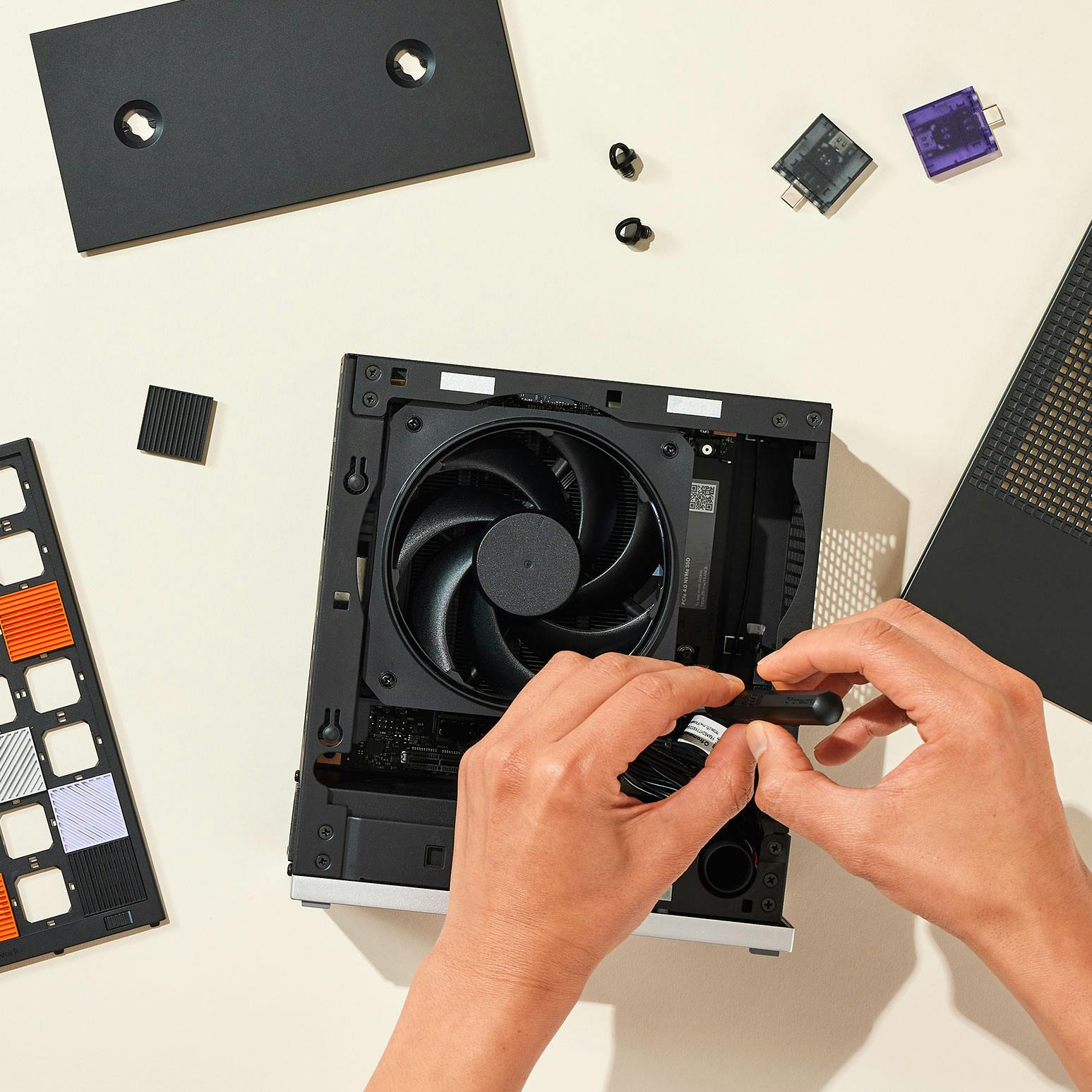
I have always envisioned a ai server being part of a family's major purchases e.g. when they buy a house, appliance, etc. they also buy a 'ai system'.
Machine hardware evolution is slowing down, pretty soon you can buy one big ass server that will last potentially decades as it would be purpose built for ai.
Things like 'context based home security' yeah thats just, automatic, free, part of the ai system.
Everyone will talk to the ai through their phones and it'll be connected to the house, it'll have lineage info of the family may be passed down through generations etc, and it'll all be 100% owned, offline, for the family; a forever assistant just there.
  - 6× faster CPU/GPU performance
  - 6× faster AI performance
  - 7.7× faster AI video processing
  - 6.8× faster 3D rendering
  - 2.6× faster gaming performance
  - 2.1× faster code compiling
Over the span of 5 years.
Plus, realistically what makes an "ai" server different from a computer? This "lineage info of the family may be passed down through generations" sounds nice but do you know anyone passing down a Commodore 64 or Apple II that remains in daily use? I fail to see how "ai" would protect something from obsolescence.
It depends on what/how you're comparing. Core to core, according to CPU benchmark, the M1 is 5800 vs the M5 at 3600, so we're still not quite to 2x.
Overall system performance is better at about 2x improvement thanks to extra cores/other improvements/changes. I could see other more specialized benchmarks improving more thanks to different improvements/core/power/size improvements in other components (GPU/NPU/etc...).
I have a good analogy. 10 years ago, I was convinced that a 24-inch 1080p monitor at arm's length was perfection. There could never be any reason to improve over it. I could do everything I ever wanted to, to a standard I would never need to improve upon.
Yet here we are. The simplest and most obvious improvement is a 24" 4k monitor at 200% scaling. Basically, better in every way.
There's a discussion to be had about whether you need the better setup, which I think is your point, but there's no denying you'd want it (all other variables the same).
Today, not much differentiates them. But as time passes our only option will be to further specialize the hardware to get realistic gains; at some point perhaps a 'purpose built analog' computer kinda thing will get to the point where it is so useful, that it would be like the 'Standard Template Constructs' concept in Warhammer 30k. So what you can make a faster ai but, the current one can 'teach everyone, basically anything'.
If you bought a big ass server for your home 10 years ago it probably wouldn't have even have had a GPU/AI accelerator at all. If it did, it would have been something with wimpy compute and VRAM because you needed the video encoder/decoder for security cameras or the like.
I'm not sure that really gives confidence hardware has really slowed down enough to invest in it for decades. Single core CPU performance has but that's not really what new things are using.
It really just depends on if the hardware is "good enough" for whatever its purpose is. If the hardware today can locally run whatever models for your security cameras, it's likely they will still be "good enough" in 10 years.
Of course, similar to a 10 year old car or appliance, you will be missing any new features or bells and whistles that have become available in the meantime.
I agree; it's important to recognize that there are lots of use cases where computers have long since reached "good enough" and aren't really going obsolete anymore for those use cases.
My NAS is about 13 years old, the network switches it connects through are even older, and while 2.5GbE now exists I have no need throw out my "good enough" equipment to replace with something marginally faster or more power efficient. I don't even really need to expand the storage of that NAS anytime soon, because my music collection could never come close to filling it, my movie/TV collection isn't growing much anymore due to the shift to streaming, and the volume of other stuff that I need to back up from my other computers just isn't growing much over the years.
You’re kindof undermining your own point. Ten years later the only thing you’d need to upgrade for your home server might be the GPU - because a new use-case emerged. Okay? Spend $500-$1000 on an eGPU. Problem solved. Will that eGPU setup last another ten years? If all it’s doing is processing security video and routing claw-like tasks, then yes.
Not sure I follow why - that the server from 10 years ago would be completely unfit for purpose now should not imply the one you buy today would therefore be the right hardware 10 years from now. Unless you can somehow guarantee we've reached the final set of new requirements we will ever have just these last few years the GPUs you buy today will probably be just as irrelevant to the new requirements a decade from now.
Of course one can always upgrade components piecewise as requirements change, but I don't see why you need to invest in a big ass server to do that. It'd be cheaper to go that route everyone has for decades at this point - upgrade with normal sized stuff as needed and not try to make it an up front multi-decade home investment out of it.
On the flip-side, if you intentionally plan to lock in the capabilities to the kinds of things one can run today and know you'll never therefore need to upgrade it then you can get whatever sized system makes sense for today's needs. You just need to be really sure you'll not be interested in "the next big thing" when it comes too.
Decades is a long time for hardware, but "years" seems reasonable soon. The commercial models are "good enough" for a lot of things now, so if that performance makes its way into the on-device space for "home applicance"-level cost (<$5k at the start, basically), I'd expect a lot of stuff to start popping up there. In offices too.
Like the PC in the 80s starting to eat up "get a mainframe" or "rent time on a mainframe" uses.
Yeah but, how long do mainframes last? Think of the COBOL systems used in government. No reason to update them, they worked forever; their job is discrete and they performed it well enough where intense updating wasn't a requirement.
You also need to ask: How much do mainframes cost? They were engineered for backwards compatibility and reliability, with built in redundancy you don't find in consumer hardware.
AI models are changing every other day. I have to rebuild llama.cpp from source regularly. We are no where close to a personal "AI mainframe."
I don’t think there’s anything different between what you’re suggesting and a homelab. Most people do not have a homelab and are happy to offload services like photo storage or security to remote providers.
I think that attitude is (very) slowly changing though and might not be the default forever.
My elderly parents have asked me about "local backups" of their cloud stuff, their Facebook history etc..
If they're thinking about the risks/tradeoffs of being in the cloud..
I think people use the cloud because there's no better/easier option today.
But at some point there might be. A home appliance (which may be similar to a homelab under the hood but the user experience is where things change) that provides a bunch of automation and home services could be quite attractive if it got to a point of being very turnkey for the average family.
There’s no better option today because it’s impossible to make it a better experience. That machine at home will need upgrades, it could fail, it costs thousands, it sucks lots of power. There is no mass market appeal.
Strongly agree. Plus, for all but very specific usecases, most people will spend less money by paying for cloud services, with "most" here referring to the general population.
Home labs feel wholly different and requires custom setup and maintenance.
A home appliance like a toaster would be in the case of an AI server are ready to go appliance that’s preloaded and confined and connect to everything in your home and help you manage it likely by just voice chat or some amount of interface.
What you’re describing is more likely to manifest as a proprietary product from someone like Samsung or Ring (likely both!) than an open standard AI server that integrates with everything in your home automatically. This is exactly like what we have today with security systems and smart appliances. You have managed services and you have Home Assistant in your homelab.
Even if that happened tomorrow, I suspect we'd have _at least_ a decade of people tweaking/optimizing designs on the same node to squeeze meaningful performance upgrades out. Eg, coming up with hardware support for new int/float formats that make more sense for the models of 2029, running matrix operators on ram chips directly, etc.
I remember back in the early 2000s when people thought we were running out of steam on the advancements front. This was roughly around the time when CPU clocks stopped getting faster. Pentium hit 3GHz in 2005, Intel Core Ultra 5 performance cores are generally around this exact speed 20 years later.
Since at least the 640kb quip, betting against progress or the appetite for progress has been a losing bet.
There's potential case for a subscription model to keep security updated for the connection to the users' phones as well as on going support for less tech savvy users (e.g. "I told my assistant to turn on my smart dishwasher and it turned on the my smart washing machine instead"). I'd imagine the HN crowd would lean toward a open source version though.
If dishwashers were invented today they would be rented out to homes and businesses with DRM to lock you into buying approved detergent and tableware. Times change, and more exploitative arrangements are normalized. This ratchet is primed to go in one direction, and only moves the other way in fits and starts borne of great effort.
Well, custom/bespoke training for your families particular needs perhaps, performed once every 5 years.
I mean I envision analog/custom/bespoke ai hardware that is fundamentally 'good enough'. I mean as the market increases its need for these systems and as time progresses at some point it'll like warhammer 30k where these 'standard template constructs' are smart enough to basically teach you anything.
Based on our current trajectory, it seems more likely everyone will upload everything to the cloud and pay perpetual royalties to access their own data.
I really think this is a temporary scenario, there will be advancements in ai's building the next generation of ais, where the scale of the model continually shrinks and maybe there will be some break through that allows us to double the use of existing hardware/memory etc.
10 years ago I couldn't do alexa at my house, now I'm pretty close with a Qwen3:8b / Ollamma LLM (I mean I never really wanted alexa to do anything other then play music, automate stuff, etc. zero interest in it teaching me how to code).
I'm even thinking at some point we'll consider ai to be a fundamental human right to have access too as otherwise you are inherently in a disadvantaged position in terms of wealth prospects to those who do have access.
This is your reminder we're in a bubble inside of a bubble...
Most people don't even think about running network cables or mesh wifi when building a house, no one will buy a server to run ai in their physical home
This is a very flashy page that's glossing over some pretty boring things.
- This is a benchmark for "home security" workflows. I.e., extremely simple tasks that even open weight models from a year ago could handle.
- They're only comparing recent Qwen models to SOTA. Recent Qwen models are actually significantly slower than older Qwen models, and other open weight model families.
- Specific tasks do better with specific models. Are you doing VL? There's lots of tiny VL models now that will be faster and more accurate than small Qwen models. Are you doing multiple languages? Qwen supports many languages but none of them well. Need deep knowledge? Any really big model today will do, or you can use RAG. Need reasoning? Qwen (and some others) love to reason, often too much. They mention Qwen taking 435ms to first token, which is slow compared to some other models.
Yes, Qwen 3.5 is very capable. But there will never be one model that does everything the best. You get better results by picking specific models for specific tasks, designing good prompts, and using a good harness.
And you definitely do not need an M5 mac for all of this. Even a capable PC laptop from 2 years ago can do all this. Everyone's really excited for the latest toys, and that's fine, but please don't let people trick you into thinking you need the latest toys. Even a smartphone can do a lot of these tasks with local AI.
Thanks a lot for your feedback :) I've noticed the slow down of QWEN3.5, so I turned it off thinking mode, the thinking mode even count words like ( 1 count 2 the 3 words, lol which is very funny ).
You are very correct, I just have 2 days of the MBP PRO 64GB on hands, so the test is just covering LLM part -- the logic handling.
For VLM, LFM is the best, even 450M works, I'll update soon :) Thanks again for your deep understanding of LLM/VLM domain and your suggestion.
Where to lean what is good for what? I start experimenting with LM Studio and have a mini m4/16gb and m4 pro/24 and wanna have locally something to work "like" Claude for just coding (mostly rust and sql).
You are right. I have Mac mini M2 16GB, it does hold all the cameras I have.
Small models like QWEN 9B + LFM 450M handle their security job nicely with < $400 budge.
Will extend the test to more model and thanks again for your insight.
The M5 Pro just dropped, so here's a real AI workload instead of another Geekbench score. We run Qwen3.5 as the brain of a fully local home security system and benchmarked it against OpenAI cloud models on a custom 96-test suite. The Qwen3.5-9B scores 93.8% — within 4 points of GPT-5.4 — while running entirely on the M5 Pro at 25 tok/s, 765ms TTFT, using only 13.8 GB of unified memory. The 35B MoE variant hits 42 tok/s with a 435ms TTFT — faster first-token than any OpenAI cloud endpoint we tested. Zero API costs, full data privacy, all local. Full results: https://www.sharpai.org/benchmark/
Thanks for sharing the results, but it's getting hard to cut through all of the AI generated hype on the page and in your comments to understand what's being testing.
Between the all the em-dashes, this:
> Zero API costs, full data privacy, all local.
and the way your comments have completely different voices it's pretty clear that you're letting AI write some of your HN comments, too.
Is there some place we can quickly go see what's actually being tested? The landing page has non-clickable entries for the categories
Currently the barrier to entry for local models is about $2500. Funny thing is $2500 is about the amount my parents paid for a 166 MHZ machine in 1995.
I remember my Dad buying a 386 25MHz a few years earlier for a similar amount.
In 1984 he bought a TRS-80 for almost a thousand dollars. 32kB RAM, around 1 MHz 8 bit CPU.
I bought a Pentium 90 in the late 90's for several thousand dollars. It had the FDIV bug in it.
After experiencing a lifetime of high depreciation in electronics, I'm extremely price sensitive when buying it. I feel that if I wait a few years everything will become much cheaper. Maybe that's not the case with the slow down in Moore's law and the AI datacenter build out.
My first 'real' machine was a Price Club (now Costco) 386sx for $3800 in late '89, which would be nearly $10k adjusted for inflation. 16 MHz, 1 MB RAM, 40 MB hard disk.
That was bargain basement for that era. IBMs, Compaqs and the like were ~$5k similarly configured, and the first 486s were in the $7-9k area.
Look this isn't an ad. I've been building my own desktops since I was 14. It's always been a CPU and motherboard and memory separate type of deal but this thing has it all integrated. Look how small it is. I use Gentoo. I compile all the things. I know exactly how long it takes to compile gcc because I do it all the time.
This thing compiles the linux kernel in 62 seconds. And it uses less power than my current machine to do it. I am jealous. The computer age is not slowing down. It's in fact speeding up. Am I the only one excited as fuck about what's coming?
You don't even need a GPU because it handles gaming tasks like it's nothing.
I bought one of those 6 months ago when the top spec was $2k, now it's $2700 yikes. Very happy with my purchase. I picked this precisely because it's the only non-apple with that unified architecture for memory. I still wanted to put kubernetes on it so it's important it's not a Mac.
This is very false. My first system was a 3060 which you can buy new for about $300 or used for about $200. If you already have an existing system you can use it, else you can pick up a used PC for about $150. Entry is about $500.
Perhaps OP was referring to a usable agentic system, for which $2500 sounds about right.
I've got a 3060 myself, which is nice to play around with the smaller models for free (minus electricity) and with 100% uptime, but I was not able to program anything with them yet that I didn't want to rewrite completely. A heavily quantized Qwen3.5-27B model is getting close though. Maybe in a few months.
I was actually thinking of the AMD Ryzen AI Max+ 395 which compiles the linux kernel in 62 seconds and is the first usable integrated graphics solution I've seen.
Strix Halo systems were ~$1500. They've gone up in price due to demand, but that is a perfectly usable "agentic system" (whatever that means). If 128GB VRAM and a fast GPU isn't good enough, I don't know what is.
> Strix Halo systems were ~$1500. They've gone up in price due to demand
The price hike has been crazy. The Bosgame M5 Mini is $2400 now. I didn't get one last year when they were $1500 because I thought the memory bandwidth was mediocre. However, it doesn't look like we'll get anything better for that price anytime soon.
I have also 4070 laptop version during heavy discount season, before 50series came. And upgrade to 96GB DDR5 when it's cheap...
So I like LFM 450M + QWEN 9B Q4, they are good fit to 8GB VRAM.
In the other reply you said 50k. 16GB vram provides 40-70k on the 9b depending on the implementation and quant. Which is more than enough for the tool we are discussing in this thread but it looks like you are just changing your story instead of admitting that your initial comment was made in a hunch. Adding ever changing context in responses "to be right" is just bad manner.
50k is what I consider bare minimum but I would like to have 100k. Honestly I'd like to have as much as I can get. Context window is what makes it useful. I wanna feed it all the information at the same time. If I can feed it my entire code base it becomes much more useful than if I feed it only some of my code base.
This is fantastic, but IMO it misses the most important part of a home security system from a business PoV - the ability to issue an alarm certificate. These are required for insurance discounts, as well as for making certain claims in the event of loss.
This is the classic issue in tech right now - it's becoming easier to build the systems, but the compliance/legal hurdles are still real, slow, and human. Even if the monitoring is best in class (which I'd argue it likely is - this is a fantastic application of AI), if the compliance isn't there it wont be a real product.
The Qwen 3.5 models are currently the best open-source models, but they are far behind proprietary models in speed and accuracy. I'd say they're about 60% on par with OpenAI and Anthropic models.
Can someone share how this stacks up to a Frigate? What I am struggling with this is how it sits in the security stack. Is it recording things of interest with motion or is it only a layer on top of the existing nvr
Why is there so much interest in local AI systems, am I missing something? Cloud providers have scale and expertise that would allow for much bigger throughput at lower costs. The small latency gains will be nice, but ChatGPT and Claude already come through blazingly fast via their API.
LLMs are powerful systems that eventually may be a requirement for being able to economically participate in a large portion of the economy. For this and other reasons it's important that people are able to control their own LLM.
Look at how much Google has changed over the years in the pursuit of profit. What will ChatGPT and Claude look like when they are pushed further down the profit maximization path?
1. Local models become more capable
2. you can easily fine-tune them
3. availability of certain cloud models and your access to them is something you can't control
4. privacy of your data
The product being evaluated is a home security camera agent, its user base is HomeAssistant-adjacent. Value here is privacy over latency (23tok/sec isn’t amazing for a vision model)
I find it so incredibly freaking cool that the machine sitting next to me can generate code, images, and prose based on natural language prompts. It's cool that any computer can do that, of course, but it hits different when it's the one right here in my apartment versus a server off in the ether somewhere. It's the sort of thing I think about it in utter amazement as I fall asleep at night.
I don't know if that's why other people are interested. I'm probably weird. But that's what drives my interest.
Do you want to have connect to your existing HA instance or okay with a new docker instance?
I was planning to have both but would like to know which one makes better sense.
Yeah, but it can be a bit of a tight squeeze if you don't have at least 24gb (preferably 32gb+) of memory.
Especially if you want other apps to run at the same time, I think it's safer to stick with something more like 9b. You can see a table with quantized sizes here [0] -- yes, there are smaller quants than Q4_K_XL, but then you're down in the weeds with nickel-and-diming things, and if you want to even keep something like a (memory-hungry) instance of VSCode running, good luck.
This seems like an inevitable idea: a security system with full context. So you don't get alerts about your friend's car plates or your kid coming home late.
Are we “there” yet? To the point where deploying this as a serious security system makes sense? Or are we still in the research and demo phase?
My intuition is that OpenClaw-like systems still make too many mistakes to be trusted with security. And that it will take more months or years until the models and harnesses are truly ready.
Edit: and while the parent comment and this are made in at least part jest, the discovery of bugs and emergence of adversarial and secondary uses will be interesting.
For example, imagine being able to run gait analysis for neurological disorders against yourself from your own security cameras.
Not necessarily. But fixed code tends to not adapt to changing situations.
“Hey, my mother-in-law is coming today. She drives a blue Ford pickup. Let her in and record the car plate for future use.”
“There are servicemen coming today around noon. They should check the electricity box and leave in a few minutes. Let me know if they do something else.”
Thanks for pointing out Unifi Protect, as long as the camera supports ONVIF(RTSP), then it could be connected, please let me know more, I'm not familiar with Unifi Protect, will do more research...
Yes you can get an RTSPS stream, but looks like Aegis is doing some validation that won't accept them. They look like - rtsps://192.168.1.1:7441/uOndh6hJd3Bti4kd?enableSrtp
Oh, sorry about that. I didn't test RTSPS stream, what model is it? I'll go by one and test. Before then, I'll check the flow to loosen the validation.
Let's prepare a release for this ...
There are many different models, but all should come up with similar RTSPS stream from Protect. Let me know when you cut a new release and i'll try it!
I'd like to recreate this benchmark using Qwopus on my M5 Max. I am curious if the theoretically improved reasoning capabilities from distillation improve its scoring. Adding this one to my to-do list for some point in the next few weeks.
I've been doing a lot of experimentation with Qwen3.5 models locally, and I've found for other tasks that the Opus 4.6 distilled versions of the model ("Qwopus") tend to perform better for other tasks. But this is mostly based on the quality of output, not necessarily from a performance perspective. I'll report back once I get around to running the benchmark. I'm also interested in applying local AI tools onto my local security setup (built on UniFi).
I just received one report that UniFi is using RTSPs, one fix is to loosen the RTSP string pattern, a release version is uploading ( 0.2.7 ).
I'll find one UniFi camera to test secure RTSP streaming.
Neat, but why would you want a clumsy LLM to know what happened with your security system? Things happened or they didn't, and that's what dashboards are for.
Seems like trying to make a need from the tools. My security system front page shows me every event that happened at my house, and I don't have to interrogate it on every happenstance, and I don't see what the value of that is.
Why would you run this on your M5 instead of a dedicated machine for it? A Jetson Orin would be faster at prefill and decode, as well as cheaper for home installation.
Context is your limitation, on the M5. The larger your model is, the longer you'll be waiting on token prefill. TFTT with 0 tokens of context isn't a real-world benchmark.
That's why most professional inference solutions reach for GPU-heavy hardware like the Jetson. Apple Silicon seems like a strange and overly expensive fit for this use cae.
I'm not a hardware expert here but this strikes me as inaccurate, though the actual performance can be scenario dependent.
The Jetson hardware is targeted to low power robotics implementations.
The Jetson Orin is currently marketed as prototyping platform, and I believe it does not generally challenge recent Apple Silicon for inference performance, even considering prefill.
In the latest Blackwell based Jetson Thor, the key advantage over Apple Silicon is its capable FP4 tensor cores, which do indeed help with prefill. However, it also has half the memory bandwidth of an M4 Max, so this puts a big bottleneck on token generation with large context. If your use case did some kind of RAG lookup with very short responses then you might come out ahead using an optimized model, but for straightforward inference you are likely to lag behind Apple Silicon.
At this stage, professional inference solutions ideally use discrete GPUs that are far more capable than either, but those are a different class of monetary expense.